Welcome to Pohl Vault, a collection of reflections on being a middle school language arts & social studies teacher.

December 28, 2013

Dreaming of Demons: Using the Rule of Three to Modify Teaching Texts

Last spring, I was reading the news and stumbled across this article, "Strange Sleep Disorder Makes People See 'Demons'". Hmm, I thought to myself, this could make an interesting fantasy story. I saved the article to my computer for some future date. This summer, when I had some time, I wrote the story that had percolated for a couple of months, and called it "Demon Dreams".

Here I am in December, and we are in the first weeks of our new fantasy writing unit. As with all fiction writing units, the first lessons were focused on gathering ideas using a variety of strategies. I decided to throw in the strategy of "Use ideas from the world around you" as one place to launch into story ideas, and shared the sleep disorders article with my classes. There was quite a buzz that day with "What ifs" flying around the room. I shared with them my quick story blurb based on this article:
image from wikipedia
What if there was a girl who was obsessed with the Mortal Instruments series (City of Bones series by Clarissa Clare), and really wanted to become a Shadow Hunter. She reads this article and decides to create demons from her dreams, and then fight them. It takes her several tries, but then she succeeds. Now, I haven't decided yet how I want it to end. There are several possibilities: she could kill the demon and win, the demon could kill her, or maybe there's something else, which I will keep thinking about.
By the end of the gathering week, students had settled on a blurb that they could commit to, and wrote it in a way that they would remember the idea when they returned from their 3-week winter holiday.

As I was looking ahead to the drafting lessons, I returned to my finished "Demon Dreams" short story to modify sections that we could work with. According to Mary Ehrenworth at the TCRWP Writing Institute, mini-lesson model texts should be based on "The Rule of Three": One place where the teacher shows the students how to use the strategy, one place where the teacher and students can work together with the strategy, and one place where students can work by themselves with the strategy.

I will start with this first drafting mini-lesson (all teaching points from Calkins, Lucy. "Realistic Fiction/Social Action Fiction" in A Curricular Plan for the Writing Workshop--Grade 7, 2011-12. Portsmouth, NH: Heinemann, 2011): 
“Writers often think of a story as having three parts—one part where we meet the characters and find out about the setting as well as hints of the problem, one part where the critical problem is faced and choices are made, and one part that shows change and/or resolution. Writers don’t necessarily start drafting with part one, though—we often begin by drafting the second part, to make sure we use our energy on the most critical moment of action, decision, and conflict. Then we’ll write what comes before and what happens after.” 
When I teach this lesson, I'll share a timeline of the blurb to model the decision-making part of what to draft first. When I returned to my finished story, I found the part that focused on her attempts to create and successfully creating the demon, and I copied it onto a new document, called "Draft 1". I'll share this at the beginning of the next class.

The next lesson teaches story leads in order to help the writer get from the beginning to the middle:
“Writers try different leads for our stories. We start in different places, we write three versions of the same scene, we try different voices (first and third), or we start in various settings, to surprise ourselves as writers. Then we show our partner some of our leads and get feedback from a partner writer.”
In my finished draft, I had already written a long lead-in to the middle; it needed a sentence or two to help it make sense: "Liz read through the past couple of days of her dream journal before she went to sleep, focused on making the demon come closer." Next come some dream journal entries that talk about her attempts and the dream in which she succeeds in conjuring the demon. During the lesson, after I read Draft 1, I'll return to that new sentence and teach around what needs to come into the lead: Introduce the character: Liz takes fencing lessons, is a huge fan of the Mortal Instruments series; issue: looking for happiness by becoming a Shadow Hunter; problem: demons are evil and dangerous and Liz is just a girl; context: establish the night paralysis idea and why Liz is keeping a dream journal. We will brainstorm a list of ways to begin stories, such as dialogue, action, flashback, explanation. Then we'll look at my story. I drafted some leads ahead of time, and will share two, ask for help with a third, and have them work independently for a fourth (#2 is the lead I want to use eventually, and I'll choose one other to model how authors think of several leads before settling on one):

1.     Liz had always wanted to be a Shadow Hunter. Ever since she read City of Bones, her dream was to fight demons and live in the supernatural world with vampires, wizards, and werewolves. When she read an article that explained how some people saw demons when they experienced sleep paralysis, she had an idea. (explanatory)
2.     Liz could barely control her glee as she stepped back into the Sleep Center waiting room, photocopied instructions in hand. “I got it! Let’s go!” Robin smiled warily as she stood up from the orange plastic seat. As they walked to the bus stop, Liz launched into her plan, explaining step by step how she was going to “create a demon” through her dreams and then fight it like the Shadow Hunters in her favorite book, City of Bones. Robin walked quietly beside her. Liz finally wound down as they arrived at the bus shelter. (action- beginning chronologically)
3.     Liz lay in bed, twitching in her sleep. Her eyes rolled behind their lids, and her hands clenched. Short, sharp cries escaped from her pursed lips. She was having a nightmare, exactly as she’d planned for the past two weeks. (action- middle, and will flash back to beginning)
4.     The demon stood before her, scaly and menacing. Liz faced it with her fencing sword, feet planted, ready to fight. This is the moment she’d been waiting for. (action- end, and will flashback to beginning)
We've talked a lot about mood in stories this year, with a focus on how setting details and word choice create that mood. This is a sophisticated writing technique that eighth grade writers can handle, and fantasy stories are ripe for adding setting and mood details. Here is the mini-lesson teaching point:
“As we draft our first scene, writers work on creating a setting that is a psychological state as well as a physical one. We create a mood by something as simple as the weather, and by small details that make a place seem happy or oppressive. We also look to each of our scenes with this lens, elaborating our settings so they create a certain atmosphere that shifts throughout the story.” 
I went back to my Draft 1 and looked for a scene that included a lot of mood details. I found the scene where Liz finally meets the demon in her dream. I had written it like this:

Liz walked through a forest of red trees. It was drizzling and misty, making everything damp. Drops fell off the red leaves like blood. There was no sound. She could feel the demon presence getting stronger as she walked forward, like a throbbing in her core. Part of her consciousness told her to run away as fast as possible. She kept walking, intent on meeting the demon at last.
 Lots of great sensory detail, ominous mood, just what I was looking for. However, there is nothing for students to do with it since it's already done. I needed to cut it back to the bare bones:
She walked through a forest. She could feel the demon presence getting stronger as she walked forward. Part of her consciousness told her to run away as fast as possible. She kept walking, intent on meeting the demon at last.
In my modelling, I can explain how I want this mood to be scary and ominous, and then I can add one or two details about the forest. The class can help me add another setting detail, and finally they can come up with a third.

When we get through drafting, we also need to take a close look at sentences. We did some work with simple, complex, and compound sentences, and sentence fragments during the fiction reading unit, and now it was time to apply those sentence skills. I will use this mini-lesson teaching point:
“We can also take a fresh look at our sentences, with the lens of short and long sentences, and when to use each. A series of short sentences often create a sense of tension, which is released with a longer, serial sentence."
There is certainly an action scene at the end that could use re-writing. Here is what I have in Draft 1:

“Come on!” Liz shouted. “I’m not scared of you!” The demon ran to her in two bounds, but Liz was ready. Her sword slashed through the air, landing on its shoulder and cutting deep. It let out a howl, strangely high pitched, and lunged at her. Its teeth snapped closed as she dodged and ducked. It reared up on its hindquarters, raking the air with its claws.
It is easy to model the first revision: "The demon ran to her in two bounds. Liz was ready." The next sentence also lends itself to being broken up into short, choppy sentences. The tricky part is that "longer, serial sentence" that releases the tension. Where should it come? This is a great discussion point where we can try out different versions of the same scene, looking at the work that punctuation can do for a scene's pace and excitement, and reinforcing the idea that exploring options leads to much stronger writing at the end (I still have students who turn in first draft work, or work that has been only cursorily spell-checked).

In true Understanding by Design style, I started with the end in mind (my finished story), and worked backward to design lessons that will guide students through the writing process step by step. I used Mary Ehrenworth's "Rule of Three" to re-write my model texts so that my lessons used the gradual release model: I do it, we do it together, you do it. I have more work to do, especially around editing, which still befuddles too many students. But I have enjoyed re-thinking my own writing process, the decisions I made while writing, and seeing how my students can make my story even better.

To read my full story (without any student help), click on this link.


December 14, 2013

Critical Reading and Primary Source Documents in Social Studies

I have been doing a lot of thinking about reading instruction within Social Studies this year. This is partly due to the course I did over the summer, Harnessing the Common Core to Achieve Higher Levels of Reading and Writing (Heinemann), as I dug into the CCSS informational reading standards. This is partly due to dissatisfaction with my students' abilities to unpack meaning in a primary source document or a news article. And this is partly due to recognizing the need to bring in more supplementary resources instead of relying so much on the textbook.  

To this end, I have taught my kids how to annotate texts based on Cris Tovani's work (see my post Annotations as Assessment). They have annotated Q & A articles about Native Americans from Do All Indians Live in Teepees? (Smithsonian, 2012) and an article from the Washington Post about new anthropological evidence from Jamestown. I taught a week of lessons on reading informational texts using the TCRWP text set resource "Christopher Columbus: Who Really Discovered America?" And most recently, we had a guided unit on The Historian's Process in which students read and analyzed primary and secondary sources, both visual and written, to validate or invalidate historical questions about the early English colonies.

They are making progress However, primary source documents are difficult to understand for grade 8 students. The spelling catches them right away, and it is hard for them to get past non-standard English spelling to the meaning behind it. They use really long sentences, and each phrase is a meaning-packed unit all on its own. This can be exhausting for modern readers who are used to short, clear sentences. Finally, they use big words, or unfamiliar words. I am continuously surprised by the words they circle in their annotations with "What does this mean?" written in the margin. We need to do more context clue and word analysis work.


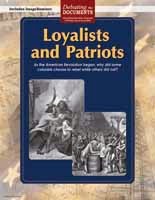
Usually at this point in the curriculum I turn away from the primary source focus and get back to role play and textbook reading. However, this year, I want to keep going with it. Fortunately, I found what I was looking for in my Social Studies closet: Colonial America: Debating the Documents (Social Studies School Services). This handy resources sets up 9 different debatable questions around topics related to Colonial America. A few topics are now too old to return to, such as the Pilgrims and Anne Hutchinson, but there are three that fit right in with what we will be discussing next: The Great Awakening, Loyalists and Patriots, and The Declaration of Independence. 

Each 4-5 day mini-unit presents primary source documents, both visual and written excerpts, that consider opposing sides of a question. Students are guided through these by looking at two to three short primary sources, answering guided questions about them, and then choosing between two as the one that historians would find most useful (with justification). This is repeated with two to three more primary sources. Next, students are assigned a "side" in the argument and debate using the documents as evidence. The final step is to answer the Document Based Question (DBQ) in a formal essay.


My teaching partner and I want to use the Great Awakening unit to introduce them to the process and do more work with reading skills. They will debate using a basic format used previously with the Columbus text set, but will not write the DBQ essay. Next, after role playing the First and Second Continental Congress, we'll re-teach and/or extend reading skill lessons and give them more independence in the Loyalist and Patriots unit, ending with a more formal and complex debate. Finally, the Declaration of Independence will be much more independent, ending with the DBQ essay as a summative assessment.

I hope three units is not too much. I don't want them to burn out on primary source documents or debates. Rather, I want them to feel comfortable and stop feeling intimidated by the formal language and difficult words. I want them to view a text and ask questions about its creator and the time period in which it was created. I want them to bring a critical, historian's eye to primary source documents and, in a best case scenario, to all texts they encounter in the world.

December 7, 2013

Reaping the Rewards of the Sprialed Curriculum

We launched into our short story writing unit yesterday. As my teaching partner and I were reviewing the unit earlier in the week, we had a pause and reflect moment. We realized three important things that impacted our planning:

  1. Our students have been writing realistic fiction stories every year since third grade.
  2. According to their personal narratives earlier in the year, they are good storytellers-- focusing in on moments, using dialogue and description to show, not tell, and developing one character.
  3. They are fanatics about fantasy books, especially dystopian science fiction and modern mythology.
And so we turned to the Grade 8 Curricular Plan for Writing Workshop (Calkins & TCRWP, Heinemann, 2011) and its Fantasy Writing Unit to modify our realistic fiction unit into a fantasy unit. This propelled us to consider lessons about making fantasy settings realistic (or at least believable), introducing magic early in the story so that the amazing object or power that saves the day doesn't come
out of the blue, and keeping tight control over the length and focus of the plot. It also sent us back to our bookshelves to find mentor texts that are short and highlight the teaching point within the fantasy genre. It was a bit of a scramble because of the narrow time frame we'd given ourselves, but it was worth it when I heard the loud cheer that greeted the announcement, "We're writing fantasy this year!"

Four years ago, when our group went to the TCRWP Writing Institute, we were just developing the genre-based unit spiral in middle school. The elementary school was only about a year ahead of us with implementing the TCRWP Units of Study in Writing, so our students coming into middle school were also new to the spiral. As we looked over the middle school units, which included historical fiction in grades six and seven, and fantasy in grade eight, we knew our kids just weren't ready for them. Nor were we. We agreed to stick to realistic fiction, also units in the grades six and seven curricula, so that our kids could solidify the short story fiction genre.

This year we get to reap the rewards of the spiralled curriculum. Our kids, and we teachers, are ready for the new and exciting challenge of fantasy writing. We will build on the solid base the students already have as fiction writers, inserting new twists to an established skill set. We will add scaffolds and reteach previous grades' lessons for those who have not yet reached the level of the rest of the class, either because of development or because they are new to our school. And we will open up the world of imagination to a group who is steeped in futuristic settings, magical worlds, mythological creatures, and sophisticated issues of tyranny, power struggles, discrimination, and environmental collapse. I can't wait to see what they come up with!

December 2, 2013

Book Ladders Part III

Here it is, December already. Nearly half the school year has passed. In that time, we have made some progress with our classroom library/book ladder/text complexity project. Here's an update:

  • Only 3 of the 6 of us chose this work as our professional goal this year. Two others wanted to dig into our new school-wide communication and grading system, Veracross. One other wanted to start a blog after going to a tech conference. I have to admit that I am disappointed. Without a departmental goal that all can work with, we have lost a lot of cohesion. 
  • The grades 7 and 8 classroom libraries have been inventoried and leveled. Except for my own inventory, which I did myself, our Teaching Assistant tackled that job. There are holes and errors, which teachers are just now discovering, but it definitely saved hours of their time to have her do it.
  • We downloaded the book lists from the Teacher's College Reading and Writing Project site. Each genre or thematic list is arranged with titles from most simple to most complex within a leveling system, first the guided reading A-Z system, and then the Lexile system. 
  • We highlighted the books we already have on that list (well, our TA did that part too, again with some holes and errors but still worth it).
  • Since it is ordering time, we ordered books that fell between our current books on the list to fill out book ladders for next year.
  • From the current and order list, we created a couple of book ladders that reflect the books in our classroom libraries.
I want to talk about that process a little bit. The TCRWP Fantasy book list is a long one that jumbles all kinds of fantasy together, from classic fantasy books like Eregon, to paranormal fantasy like City of Bones, to science fiction like Divergent. This made putting a book ladder together using just the TC list difficult and confusing, especially since kids tend to stick to one sub-genre for a while.

So on our Professional Development Day last week, the three of us sat down in my classroom to make a dystopian novel book ladder. This is a genre that many of our kids are reading right now, and we share a lot of the same titles on our shelves. It seemed a logical place to start.

Image found on olx.in website
With the classroom library inventory opened on our computers, we pulled as many science fiction dystopian books that we knew off the shelf and piled them on a table (there are probably more, but I haven't read all the books on my shelf yet!). Then we got sticky notes and we labeled the books based on our inventory's leveling information. Sometimes that level was a guided reading letter (T-Z), sometimes it was a Lexile score (usually between 650-850), and sometimes both.

Because we are hands-on, visual people, we lined up the books that had letter levels first, from easiest to hardest. Next, we slipped the Lexiled books into the line where they seemed to fit. Then we took a step back and frowned. Should the Shadow Children series (level Z) (e.g., Among the Hidden) be higher than Insurgent (Lexile 710) just because it has a dystopian theme? Considering length alone, the Divergent series seemed more challenging, as well as having a more complex plot and more complex characters. And what about Gone (Lexile 620)? It's a massively thick book, but not a complex storyline. Is there more to think about, infer, and discuss in Among the Hidden than Gone? We thought so, and put it behind the Shadow Children books.

In the end, we had a line-up we could live with. Next, we put together book labels for the backs of the books. These said: "If you liked this book, try (the next book in the series, or the next one up the ladder). If this book was not right for you, try (the next one down the ladder or one that is similar in level)." We felt this could give students more self-sufficiency as well as "save face" if they were reading low on the ladder.

Although we had a 3-hour chunk of time to work on this, we only got the one dystopian book ladder done. However, I think we needed to figure out what we were doing and how we would do it before we could get started. Now that we have done the one, we can go on and do others. I think I'll do the Social Justice book lists next, since we just finished that theme in our novel book club unit. Exciting!