Welcome to Pohl Vault, a collection of reflections on being a middle school language arts & social studies teacher.
Showing posts with label collaboration. Show all posts

November 5, 2016

Experiential Learning: "The service was the best part!"

I just spent a week with 80 eighth graders in rural Thailand doing service- and cultural-learning activities. To many, this seems like a nightmare scenario: goofy young adolescents? an international trip? what about safety/ managing the drama/ all that whining? did you sleep?

Yes, there was some of that middle school stuff, but overwhelmingly it was an amazing life experience. The group we worked with, Rustic Pathways, was super organized, had lots of staff on hand, and made sure everyone was involved and having fun. They organized six service projects for us to participate in over the course of our week:
  • Welcome Homes (we built an external bathroom for a family-- lots of cement mixing and brick-laying)
    • English Camp (we taught basic English words to 13- to 15-year-old Thai students using games)
  • Fish & Sticks (we built a fish nursery our of wood poles and netting, and purchased baby fish to populate it for a local family)
  • Buddhist Life (we talked to a monk about Buddhism and how he lives his life as a monk, and we planted lime trees in the temple garden)
  • Hands in the Dirt (we made new garden beds for a local family to grow long beans and sweet basil)
  • Meals on Flip-Flops (we bought ingredients at the market, cooked them up, packaged the food, and delivered meals to 30 elderly people in the local village)
We also learned a lot about Thai culture, including customs, some basic language, food, a traditional dance, and some history, especially about the King who had recently passed away. Our favorite cultural activity was No Reservations: a culinary "trick or treat" route on Halloween night. It featured foods that are traditional in Thailand that are not often seen in other parts of the world, including crickets, grasshoppers, bamboo worms, chicken intestines, and coconut rice cooked in a bamboo stick.
It was interesting to see how the students responded to both the service and the cultural activities. For some, building and digging were fun, but trying to communicate with someone who doesn't share your language was very intimidating. For others, they loved hearing the elderly people's stories and teaching the Thai students, but had never held a saw or hoe in their lives. It worked the same way with the "trick or treats": one American boy (new to international life) loved the insects and didn't really care for the coconut rice, while others wouldn't try anything. Of course, there were kids who jumped into everything-- service or cultural-- with both feet.

As a final reflection, the group leaders asked students to think about something they wanted to start, something they wanted to stop, and something they wanted to continue. Almost all of the students in my group mentioned that they wanted to do more service-- easy to say, harder to do, but if even a handful make an effort to keep finding service opportunities, then it's worth it. It also bodes well for our high school program which has service as a pillar of the program. By doing this "service survey", I hope students will be more open to signing up for projects, as well as having a better idea of the kinds of service they want to do (for example, building houses with Habitat for Humanity, working in an orphanage, or building water projects in drought-stricken areas). 

Several students also mentioned how they had tried new things or did things they didn't know they were capable of doing, and how much they learned about the value of collaboration to achieve a goal. At the tender age of 14, that's pretty big stuff! I think every student was challenged in some way this week: physically, mentally, or emotionally. That is something that is very hard to achieve by staying within the four walls of the classroom.

Yes, it was exhausting. Yes, there were times when adolescent social drama nearly did my head in. Yes, traveling internationally with 90 people is challenging. But it was so worth it! As one student spontaneously blurted out in the middle of our bus ride home, "The service was the best part!"

September 3, 2016

U.S. Elections Projects: "Fair and Balanced"

As a teacher of U.S. History, I cannot ignore the momentous happening of a Presidential election, even though I am teaching in a Middle Eastern country to international students. Our kids walked into the new school year from summer vacation with their heads filled with news, ads, and dinner table conversations about the candidates. Passions were high, and misinformation rampant. 

My grade 8 colleague and I knew we needed to harness the energy around this topic without letting it devolve into a "my candidate is better than yours" playground fight. We needed to find a project which allowed students to learn about the candidates and issues in an objective manner so that they could make informed choices rather than being swayed by the latest sensational headline or the loudest voice. We needed a way for students to agree or disagree with a position and back up that opinion with factual information, rather than fighting for (or against) a particular candidate. Just like our professional meeting norms, we wanted them to "disagree with ideas, not people" to keep things from getting too personal.

CC image from Wikimedia Commons website
We decided against doing a traditional campaign ad project. First, the vast majority of our students already backed one candidate, which makes those that favor the other major candidate feel outnumbered and isolated-- never a good idea in middle school. Secondly, if we "assigned" a candidate to students as a way to get a more balanced view, those students who had very strong feelings against that candidate would instantly shut down-- again, never a good idea to lose motivation with middle schoolers.

By G. Skidmore on Wikipedia
Therefore, we decided to make our project revolve around issues, and to include the top four candidates instead of only the top two: Jill Stein (Green Party), Gary Johnson (Libertarian Party), Donald Trump (Republican Party), and Hillary Clinton (Democratic Party). We formed groups of 4, and students split the candidates between themselves. We then randomly assigned the groups one issue each: Immigration, Economy, Terrorism, Civil Rights, Environment, and Gun Control. 
Image from Wikipedia website

Students researched "their" candidate's position on how to solve the focal issue. They used ProCon.org (they have a very easy-to-use 2016 Presidential Elections page that features all four candidates), the candidates' own websites, and reputable news organizations to find their information. Students did not have to agree with the candidates' positions; they merely had to find out what that position was so that they could teach their group members about it. This alleviated a lot of push-back when students had to research a candidate who was not their initial choice. They could see the logic of understanding other candidates' views in order to argue intelligently against them.

Once the research was finished, students shared out how each of the four candidates would solve that particular issue. Next, they had to come to an agreement about which position their group would support, answering this question: Which solution is best for America? This led to some very lively discussions, with lots of critical thinking around the pros and cons of each, and students defending their opinions with researched information. Some groups also learned the art of compromise when they could not agree on a single position.

By focusing the discussion on the candidates' positions on a particular issue, it kept candidates' personalities out of it (the source of much of the sensationalist news headlines). Additionally, the focus was so narrow that it avoided the question of who is the best candidate overall. It also allowed those few students who backed the less popular candidate a safe way to advocate for their candidate without getting shouted down. 

The final step was to present their findings in a multimedia project ("live" slideshow, screen-cast recording, or movie) during which the group's choice for best solution was highlighted and contrasted with the other solutions. All students were involved in creating the production, since each group member was an "expert" on one position. Interestingly, when all the presentations were finished, each class featured three different candidates as having a "best" position, and across all classes, all four candidates were represented at least once. 

When I asked students what they had learned from this project, many students wrote that they didn't know there were other parties besides the Democratic and Republican parties. They had never heard of Gary Johnson, Jill Stein, or their parties. They learned that their preferred candidate may not have had the best solution to their focal issue, and that other candidates had some good points. They learned that some candidates agreed with others on issues-- even Donald Trump and Hillary Clinton had points of agreement! They learned about the particulars involved in their focal issue, and some of the terms that were being thrown around related to them: TPP, fracking, immigrants vs. refugees, Dreamers, Obamacare, Religious Restoration Act, EPA, etc. They also learned that there are places to find accurate information, and to not always believe what a candidate or headline says is true.

We still have a couple months before the elections. Although our project is over, our discussions aren't. We will jump into early US history next week, but as the Presidential debates and other major milestones happen, we will keep track of current events. My hope is that, as the months pass, my students will listen and read with a more critical and informed perspective than they had when the year began. They will be active citizens.

October 10, 2015

How can I help at home? Parental Support Suggestions

I just finished meeting with 44 out of my 46 families during the two-day parent-student-teacher conferences last week. It was a marathon! Twenty-seven 15-minute conferences on one day, and 17 the next. Whew! Although exhausting, I was continuously impressed with the commitment shown by the parents to be involved in their child's education. 
image from room206lce.wikispaces.com website

One question kept coming up: How can I help at home? It's a tricky question for eighth graders. Most 13-year-olds do not want their parent hovering over their shoulder, "helping" them with homework. They know they can do it on their own, although some do need help with organization and time management. For those kids, we had a good chat together about structuring time, using organizational tools, and balancing homework and down time. Parents came away with some strategies to help their children with those needs.

What about the rest? And what about academics? Here are a few things I suggested:
  • Help your child read by keeping books in his/her hands. This could mean giving time to get to the library, buying books at the bookstore or for e-readers, or suggesting books off of the family bookshelves.  
  • Talk about what they are reading, not just summary, but questions about characters, author's craft, or theme. Compare this book to others: Do any of the characters remind you of any other characters in other books? If this is a book by an author you've read before, do you see a pattern emerging (is it formulaic)?
  • Discuss the social studies content your child is learning. By "teaching" family members, students process and remember information longer. Asking clarifying questions, watching videos connected to the content, and looking at maps or other resources together enriches and deepens the information.
  • Encourage authentic writing at home. I found this great chart that places best practices for teaching writing along side suggestions for teen writers (from Fleischer, Cathy and Kimberly Coupe Pavlock. 2012. "Inviting Parents In: Expanding Our Community Base to Support Writing." English Journal 101 (4): 29-36.). Here's an excerpt:
 
Parents want what is best for their kids, and they want to do what they can to help. Giving them tools that show them appropriate and authentic ways to support their children is a win-win situation. What other suggestions do you give to parents?

September 19, 2015

Ancient Civilizations of the Americas: a Historical Inquiry Project

A couple of weeks ago, I shared my learning about the shifts needed for disciplinary literacy vs. content literacy in Social Studies. Since I am a firm believer in adapt and adopt, I decided to use the historian's process in our first content unit on Native Americans. I had found a lot of great (free!) units on the Stanford History Education Group (SHEG) website during the Improving Historical Reading and Writing MOOC this summer, so I turned to the experts to see what was available and how they organize an inquiry-based "Document-Based Question" (DBQ-- I see I am talking in alphabet soup today).

Most of the SHEG DBQ units focused on the interaction between Native American groups and European invaders. Although this is important historically, I wanted to start earlier, and study the ancient civilizations of the Americas as they were before European contact. I did some searching and found a "Mini-Q" (shorter DBQ) unit on the Maya from The DBQ Project: "The Maya: What Was Their Most Remarkable Achievement?" The Maya were one of the six civilizations I wanted students to study (the others are Inca, Aztec, and groups from the Mississippian, Eastern Woodlands, and Southwest cultural regions), and this Mini-Q was set up in the inquiry-based structure I was after. I decided to use the Maya unit as my teacher model, and write my own Mini-Qs for the other civilizations. 

However, "Most Remarkable Achievement" wasn't where I wanted to focus. I wanted students to study the groups as legitimate ancient civilizations, as established and successful as Mesopotamia, ancient China, or Greece, validating their contribution to world history. Instead of achievements, I chose this question as our Mini-Q focus: Which elements were most essential for the ______ (ancient civ.) to thrive?

I divided the class into six groups of 3-4 students each: Inca, Aztec, Cherokee (Mississippian), Iroquois (Eastern Woodland), Pueblo (Southwest), and Huron (also Eastern Woodland, but important to distinguish from Iroquois for future history lessons). Each group got a packet set up in the same inquiry-based Mini-Q structure, but with information and artifacts related to their ancient civilization:
  1. Cover: Question, Graphic Organizer naming 8 elements of civilization (Government & Law, Religion, Writing & Numbers, Trade & Economy, Architecture & Engineering, Art, Technology & Inventions, and Human-Environment Interaction), a quick overview, and a list of the 4 documents they will be studying.
  2. Hook Exercise: What does it mean to thrive? Students were given a series of familiar scenarios which they rated from 1 (not at all thriving) to 5 (extremely thriving). They then picked one scenario and justified their reasoning for why it showed the most thriving. This exercise helped students distinguish between "surviving" and "thriving" so that their investigation would stay focused on those factors.
  3. Background essay: Students had little to no background knowledge about their civilization, so before going any further, they had a short essay to read highlighting distinguishing characteristics. The essay also included a map to locate them in the Americas, and a photo showing one of the characteristics. Students answered some basic comprehension questions that held them accountable for the information.
  4. Understanding the Question and "Pre-Bucketing": Students identified terms in the question that needed definition, and then re-wrote the question in their own words. This helped them process what the question was asking, giving them a better focus as they moved into the documents. Next, based on the list of documents and the information in the background essay, students predicted which three of the elements of civilization would emerge as most essential to thriving. This prediction gave them a "clothesline" to "hang" their new learning on, either confirming or re-adjusting their initial thinking.
  5. The 4 documents: Each document included the name of the document (usually an artifact), a picture of the artifact, and a short write-up about the artifact and/or information related to it. Students went through the historical thinking process for each one: Check the source for reliability, access background knowledge related to the document, do close reading that names details (What do I see?) and considers their meaning (What does it mean?) and implications (Why does it matter?), and corroborate between documents (including the background essay). I then asked them to connect the document to two elements of civilization (I gave them the elements to look at-- it's early in the year, and there's a lot of new thinking happening on this page). 
  6. Bucketing and Thesis: Once all four primary source documents had been analyzed, students made their final decision independently. They chose 3 elements most essential to thrive, and named the documents that provided evidence to support their decision. They then turned that into a "boxes and bullets" outline: the thesis is written in the box as the answer to the question, and the bullets are the elements with evidence (their reasons). I asked them to do this part independently because everything else had been done in a group, with a lot of support and scaffolding for struggling students. I wanted to see what they chose based on what they got out of working with the documents, not what their group members (especially the more vocal ones) thought.
  7. Decision-making matrix: Group members shared their boxes and bullets, and then as a group
    rated the 8 elements of civilization for how influential they were for helping the ancient civ. to thrive. Members had to justify their thinking using evidence from the documents. This was a very high-level discussion, with students arguing their point, negotiating ratings, and compromising based on the strength of the evidence. By the end, they picked the three that the group ranked the highest, and justified them with evidence from the documents.
  8. Reporting out: The group next made an 8-slide slideshow to report out their findings. Each student was responsible to explain one of the elements or the summarizing conclusion (groups of 4 = one "meaty" informational slide each), and one "thin" slide: The Question, the answer (thesis), bibliography of images, and group members. I did a mini-lesson with The Worst Slideshow in the World, to highlight tips for making good slides. Since students would be presenting the information orally, they did not need to put a lot of information on the slides themselves. The assessment rubric included multimedia, informational, mechanics, and oral presentation criteria. As students presented their slideshows, the audience took notes and asked questions at the end.
  9. Synthesis question: When all student groups finished presenting, I asked them to answer the Mini-Q question as a generality based on their notes. I wanted to see if they could identify one- to three elements that repeated across several civilizations, and if they could explain why that element is so important for any civilization to thrive. By moving from specific (their own civilization) to a generality, students show they have built concepts.
I did a variation on this project in previous years. Students had to do their own research on two of the elements, take notes, and then share out to their group before doing the decision-making matrix (jigsaw). Yes, there is value in teaching research skills, and structuring the project with self-directed research did help hone those skills. However, I found that this year students' presentations were much more substantial and informational than in the past, where they were rather hit-or-miss. Having the whole group discussion focused on all four artifacts throughout the project, using the historical thinking and close reading skills during the process, and emphasizing again and again the need to show evidence, all contributed to more knowledgeable explanations. Although the students struggled through the document analysis, needing more modeling and reteaching than I'd anticipated, the struggle was worth it in the critical thinking work I saw happening with each group. I am pleased with the results, and looking forward to our next unit!

September 12, 2015

The Paradox of the Early Days: Building Trust and Respect

image from Uberallburo website
A few weeks ago, as summer was winding down and the new school year loomed, I came across this quote from Brenda Powers of Choice Literacy: "It’s a paradox that the early days of school fly by so quickly, yet it is still such slow, hard work to build trust and respect."

This resonated with me so much that I printed it out in large font on colored paper and pinned it to my (actual, real, physical) bulletin board by my desk as I started the year. I posted it because building trust and respect early in the year is such vital work, work that sets the tone for all other work for the rest of the year, and can easily get lost in the rush to jump into the business of curriculum. And I didn't want to forget to do it. 

Oh sure, the first week was full of get-to-know-you games and setting the expectations for all things school. But that's not enough. Here are some things I do to build classroom community throughout the first 6 weeks of the year:

image by hrlab
  1. Share, share, and more share. Yes, part of the workshop structure already includes share time. But early in the year, share time IS the work. Write a little, share. Read a little, share. Reflect a little, share. "Pair-share with your elbow partner" is easiest, but it's important to get kids to share with others that are not in their immediate friend circle if you want to build classroom community. Other structures are: share across the table, two members of a table switch with two members at another table, mingle with music and share with whoever is closest when the music stops, make an appointment calendar with four other people and share with one of them, whip around the room so that everyone shares one small thing, and of course the classic (but scary for most middle schoolers) whole class share.
  2. Reader-Writer Poster: Students make a poster introducing themselves as readers and writers. This includes a short About the Author bio, favorite quotes about reading and writing, an excerpt of a piece of recent writing, and 3 favorite books with blurbs and justification for inclusion. We do a gallery walk connection activity (another share!) where students look at each others' posters and have to find 4-6 commonalities between their own poster and others' posters (no repeats!). 
  3. Six-Word Memoir: Students think about how they can capture their life philosophy, their hopes for the year ahead, or their past into six words. After drafting a few possibilities, they pick their best one, write it on a colorful sentence strip and share with others (remember #1?). These are posted on the wall for the first few weeks.
  4. Writer's Workshop: I start the year in English Language Arts by launching Writer's Notebooks because we write about ourselves in our Notebooks, and then... yep, you guessed it, we share those stories with others! Students write memories, beliefs, entries about identity and pet peeves, important times in their lives, and rewrite earlier entries to practice craft. Although this is challenging for those students who are new to Writer's Notebooks, it is a great way to learn about each other through the first 3 weeks of school.
  5. Reader's Workshop: Although it is already week 4, we are still building community and trust. Students think about their reading identities and... share those identities with others. What books do you like? What reading habits do you have? When do you like to read? What books made an impact in your life? This sets us up for a year of independent reading and book conversations. Students find others who like the same kinds of books (even if they are not "friends" socially), so that they can get recommendations and share their reading life with others who can relate.
  6. Add in fun. Building community, trust and respect can be fun, and having fun together builds community. We know the get-to-know-you games during the first week are fun. But we often forget about fun after that. Share time is a great time to incorporate fun, even if it's just playing upbeat music while they talk. Get students out of their seats, have standing conferences instead of seated. Play rock-paper-scissors or a variation (I love gorilla-man-net instead) to see who goes first to share. Have kids high five or give an exploding fist bump after sharing as thanks to their partner. Build in stretch time after focused work by playing Simon Says. 
    image from Rizomatica website
English Language Arts is a scary place without trust and respect. I ask kids to write personal stories, take creative risks, bare their thinking, work collaboratively in groups. None of that important work will happen unless class is a safe place, not just with me, the teacher, but also with their peers. Building classroom community is important work early in the school year, and it takes time. Find the time, take the time, and your classroom will be a better place for it throughout the year.

August 29, 2015

Moving into Standards-based Grading and Reporting

Our school took the plunge into standards-based grading and reporting this year. Oh, we've had standards for years, and our UbD unit planning has ensured that we at least knew which standards connected to the unit. But until the grade book and report card demanded that we specifically connect a grade to a standard, we continued on our merry way hoping our assessments captured at least some of the standards, much like flinging a handful of pebbles at a target, hoping some will hit.

We took a middle road, though: we don't have to report on every standard, just on "strands". For English Language Arts, we settled on Reading, Writing, and Listening & Speaking. They make sense to us and how our standards are organized... until we get to those units where we are using our reading to inform our writing content (e.g., literary essay and research reports), or have cross-disciplinary projects (e.g., investigative journalism about environmental issues).
cc 2.0 by Colin_K on Flickr

So this is our first Professional Learning Team (PLT) investigation: How can you use one assessment to grade and report on more than one standard strand?

There are a few sub-questions here: 
  • Is it fair to "double dip" (in other words, can one assessment be counted twice)?
  • How specific should we be about dividing up the assessment into "strands"? Could we just use one holistic score and put it in two strands? Or do we have to identify which section goes into which strand and keep track of it that way?
  • Do we even know which specific standards are being assessed on the assessment? If we were called on by a parent or administrator, could we justify the grade based on the standards assessed?
  • Does going to standards-based grading and reporting mean that we have to create more assessments, such as "artificial" tests and quizzes that get us away from our authentic assessments, so that we have enough evidence for the grade in a particular strand?
My inclination is to go for specifics, analyzing the assessment to identify where each standard is assessed and then tracking those parts for depth of student learning. This would be possible with a fairly simple template, though it would take more time before and after the assessment. Doing this kind of analysis would ensure that all the standards got assessed (and yes, we may need some more assessments, or expand the ones we have, to include all standards) and that the grade reported is actually reflective of achievement on the standards.
cc by ePublicist on Flickr

As our PLT moves through our cycle of continuous learning, we will be wrestling with these questions and others that come up. I hope we will be able to look at some models from other schools and settle on a system that makes sense for our school. 

We would love to hear feedback about what has worked in other schools. If you have a suggestion, please leave a comment!

February 21, 2015

Merging CCSS Social Studies/History Standards with Reciprocal Teaching

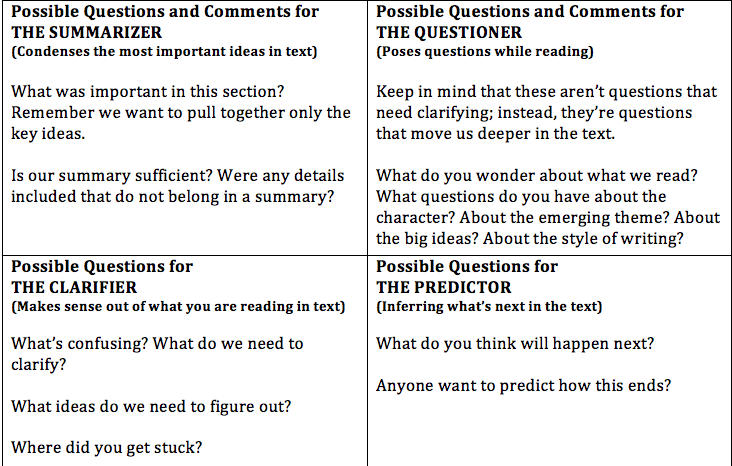
In my January post, Using Close Reading of Multiple Sources to Get Away from the "Single Story" of US History, I shared a scaffold I learned from Stevi Quate called Reciprocal Teaching. This scaffold assigns roles to students in groups of four: Summarizer, Clarifier, Questioner, and Predictor, as a way to help everyone in the group unpack complex texts. I used it with a packet of primary source materials about The Great Awakening, and noticed that students were getting a lot more out of the texts than previous classes had. 

Along the way, I added some minilessons aligned to the CCSS Literacy in Social Studies/History standards from the Teacher's College Reading and Writing Project as a way to build students' skills for reading informational texts. I connected those reading skill lessons to the Reciprocal Teaching roles: 
  • Clarifier (This role goes first after a chunk of text has been read): READING FOR KEY IDEAS AND DETAILS: Standard 1: Reading Closely and Making Logical Inferences: "Readers know that informational texts are conveying ideas, facts and examples. Our first job, then, is to make sure we read informational texts in a way that we can really “get” the information without veering off into personal connections or response. If we’ve done our job well, we should be able to turn around and teach someone else everything we’ve learned so far. We can do this by reading a short chunk of text, pausing, covering or looking away from the text, and trying to say back everything we’ve learned so far." 
  • Questioner (This role goes third): READING TO INTEGRATE KNOWLEDGE AND IDEAS AND THINK ACROSS INFORMATIONAL TEXTS: Standard 8: Evaluate Text Evidence, Weighing the Validity of Author's Claims: "Readers of informational texts consider how well an author has made his/her claim by taking a close look at the evidence used to support it. Readers ask ourselves questions like, 'How valid are the author’s claims? Is there enough evidence? Is the evidence good? Does it fit the claim and seem reasonable? Can I trust the source of the evidence? Has the author laid out the evidence in a logical manner that makes sense?”' 
  • Summarizer (This role goes last): READING FOR KEY IDEAS AND DETAILS: Standard 2: Determining Central Ideas or Themes: "Once readers really “get” the information in an informational text, their next job is to try to find the central, or big idea of the text. We do this by asking ourselves, “What is this text starting to be about?” We can think about all the details we’ve read about so far, and put them together to find the central idea. We remember to hold ourselves to what the text actually says and suggests, and not veer off into personal connections and response. This way we stay close to the text."   
These minilessons and the practice students had while using the skills during their roles kept their reading (and behavior) focused on the text in front of them.  Students felt much more comfortable digging through the complexity of 18th century writing than they did before.

Fast forward several weeks. We completed a series of "Town Hall Meetings" in which students took on the role of a Patriot, Loyalist, or Neutralist and debated whether the colonists should rebel against Great Britain (see my previous post "Practicing Argument Strategies During Socratic Smackdown". It was time to dig deeper into the issue and come back to primary source texts.

Using another set of Debating the Documents materials, Loyalists and Patriots (MindSparks, 2006), Reciprocal Roles were revived. I wanted to keep the structure from the last round, and also build more informational reading skills. I kept the Clarifier and Summarizer roles the same; students really needed the Clarifier to help them understand the difficult language of the written texts. Summarizing skills were not where they needed to be yet, so I wanted them to have more practice.

However, I changed the Predictor and Questioner roles. I noticed during the first round that the Predictor was floundering around trying to figure out what to do. When confronted with a visual document, what is there to predict? And although I liked the direction the Questioner was going, it seemed like students were ready to dig a little deeper into the idea of bias. I changed these two roles into new ones:
  • Schema Connector (Goes after Clarifier): READING TO INTEGRATE KNOWLEDGE AND IDEAS AND THINK ACROSS TEXTS: Standard 7: Integrate and Evaluate Content in Different Media: "Readers of informational texts are always thinking about how new information connects to information from other sources. We do this by comparing what we already know to new information and asking, “Does this fit with what I know? If so, does it add something new or change it slightly? If not, should I change what I thought I knew to this new information? If so, why?”  
  • Bias Detector (Goes after Schema Connector): READING FOR CRAFT AND STRUCTURE: Standard 4: Reading to Interpret the Language Used in the Text: "Readers know that even the most factual informational text is written by a person that has a personal perspective. Readers can determine the author’s point of  view and consider how that point of shapes the meaning of the text. We do this analysis by looking back on the language choices in the text. Ask yourself, 'How does the choice of words, the tone of the language, reveal the author’s point of view on the topic?' 'How does the visual style (angle, light, composition, etc.) reveal the author's point of view on the topic?'”  
Here is the new card that students used while discussing the Loyalists and Patriots packet:

These roles worked out well with the second packet. They seemed to fit the information a bit better, and helped students to understand not just what the text was saying, but to think through other important elements such as bias and validity. I liked bringing in the CCSS Social Studies/History standards and finding a way for students to practice the reading skills in a meaningful way. 

If anyone has any other creative ways to teach informational reading and/or strategies for tackling complex texts like primary source documents, I'd love to hear about it in the comments.

January 31, 2015

Practicing Argument Strategies during Socratic Smackdown

We are moving into our next phase of argument practice in Social Studies. This section, Towards Revolution, is a series of Town Hall meetings during which students, taking on the role of Patriot, Loyalist, or Neutralist, debate whether the colonies should declare independence from Great Britain. We are drawing upon the work we did earlier with primary source documents (see previous posts from Dec. 6, 2014 and Jan. 10, 2015) and adding an explanation piece (see post from Feb. 22, 2014). The Town Hall meeting itself is a game-based version of Socratic Seminars from The Institute of Play called Socratic Smackdown. Here's how it goes:
  1. Students receive a role card briefly explaining their name, stance (Loyalist, Patriot, or Neutralist), and background (materials and lesson outline from "Towards Independence." United States Through Industrialism. Teacher's Curriculum Press, 2011). These are actual historical people, including John Adams, Benjamin Franklin, John Hutchinson, Joseph Brandt, and many others (including three women). Students are paired up, so the same role goes to two students. This is a scaffold, as well as a means to incorporate collaboration into the activity. Before the first Town Hall meeting, one student from each pair introduces him/herself to the group.
  2. Students build knowledge about a series of historical events. Town Hall meeting 1 focuses on The Proclamation of 1763, The Stamp Act, and the Quartering Act. Town Hall meeting 2 focuses on The Townshend Acts and The Boston Massacre. Town Hall meeting 3 focuses on The Intolerable Acts and The Boston Tea Party. And Town Hall meeting 4 focuses on the battles at Lexington and Concord.
  3. Students evaluate the series of events using evidence to support their opinions. My co-teacher and I noticed on our unit assessment that our students did not entirely understand the "Evidence/Rule/Conclusion" chart they used during the primary source work in December; specifically, they did not quote text or include specific details in the evidence column and they weren't sure what the difference was between Rule and Conclusion. We decided to switch it to a similar, but easier, chart: Say/Mean/Matter. This chart very specifically asks students to record what the text says (quote/detail), what it means (interpretation), and why it matters (significance). We used this new chart during The Great Awakening debate, and it proved to be much more successful than the Evidence/Rule/ Conclusion chart. For this activity, students will use Say/Mean/Matter to evaluate each event. For example, for Town Hall meeting 1, students will take The Proclamation of 1763 and Say what it is (a law that states colonists have to stay to the east and Native Americans to the west of the Appalachian mountains), what it Means (colonists will not be able to expand west into the Ohio and Mississippi river valleys, there will be less fighting between colonists and Native Americans, Native Americans keep the land on which they've lived for generations), and why it matters (this depends on the role, and students will decide whether this was fair or unfair and justify why). They will do the same for the other two Acts.
  4. Students are given the question: At this point in time, how should you and your fellow colonists respond to the British government: Comply (obey without question), Oppose (protest, even if unwilling to rebel), or Rebel (declare independence). They will use their evidence chart and role card to decide what to argue.
  5. Town Hall meeting (using Socratic Smackdown): The first partner brings the role card and evidence chart to the inside circle-- s/he is the speaker and will argue their position. The second partner sits in the outside circle with a score sheet. Listeners give speakers points based on speaking skills such as Agree/ Disagree (+1), Connect and Devil's Advocate (+2), and Interrupt (-1). As a scaffold, I will provide a sentence starter for the speakers: At this point in time, I think we should ______ (comply/oppose/rebel) because British Parliament's actions are _______ (fair/unfair). For example, (name Act, what it means, and why it is fair/unfair). In past years, I have found that students want to jump straight to the Acts without the explanation that makes their point clear. For example, one might say, "I think we should rebel because the Stamp Act was unfair." I provided a similar scaffold during The Great Awakening debate and it helped students structure and support their arguments much better. I am hoping that by repeating that structure over and over, they will get the language in their heads and it will appear in their argument writing later (fingers crossed).
  6. Reflect: Students in both the inner and outer circle reflect on the Town Hall meeting. Speakers consider points that other speakers made that they hadn't thought about, as well as what they could have done better. Listeners note points they could've made if they had been speakers as well as what the speakers did well or needed improvement. They can use the Explanation continuum to help them think through how well they were able to explain their thinking. A quick class discussion gets feedback to the speakers and alerts the listeners for what to do better when it is their turn to speak.
  7. Switch seats. The process repeats for the next Town Hall meeting, with the second partner as the speaker and the first partner as the listener.
By using the same strategies in different contexts, students learn to transfer skills. They will be holding another Document-Based debate in Social Studies in a few weeks. These argument skills will work there too. They are writing argument essays in Science this month. These argument skills will work there too. They will be writing position papers in English later in the school year. These argument skills will work there too. I hope that consistent practice will help them become masters of argument by the end of the year.

January 10, 2015

Using Close Reading of Multiple Sources to Get Away from the "Single Story" of US History

Teaching history is the art of storytelling. But storytelling has its dangers, as Chimamanda Ngozi Adichie, author of my January adult book club book Americanah, warns in her TED talk "The Danger of a Single Story." She warns that only telling one story of a people leads to stereotyping and false assumptions, such as disregarding her Nigerian middle class upbringing as not "authentic", according to one of her American college professors, because it wasn't the starving/sick/poor/hard-scrabble story we Americans hear about Africans from our media. She asserts that only by telling multiple stories will we get the true meaning.

This idea of multiple stories, multiple sources, is a topic explored by Mary Janzen in her 6 Jan 2015  SmartBlog post "Using digital resources to enhance social studies, history instruction." She argues that the textbook version is too narrow, that it's the "single story", and that adding digital resources including many primary source documents, helps students to see history from multiple perspectives, without stereotyping or narrowing to only one story.

As we jump back into Early American History next week, my co-teacher and I are pushing pause before moving forward in the chronology. We finished our Colonial America unit right before the winter break, so we are going to linger for a couple weeks in some of the big ideas that formulate the Promise of America, our year-long theme. Many of the "promises" were formed during the colonial era: freedom of religion, self-governance, the free enterprise system, and equality (within contextual boundaries, of course).

One of the defining movements during the early 18th century was The Great Awakening, a time when itinerant Christian preachers spread ideas of breaking away from authoritarian religious practices, like the Puritans, and embracing the right to practice religion in a way that allows the common person to have a direct relation with God. A central tenant was that everyone is "equal" in the eyes of God, a very radical viewpoint for the times. Here is what the textbook closes its three paragraphs with: "By encouraging ideas of liberty, equality, and self-reliance, the Great Awakening helped pave the way for the American Revolution." (TCI, 2011).

So that's the single story: Preachers preached, people converted to their ideas, and the American Revolution was born. Hold on... we all know it's not that simple.

We are going to use the resource What Did the Great Awakening Awaken? (Social Studies School Services, 2007), a collection of primary source documents, both visual and written, that presents two sides of the story: the religious revivalists and the authoritarian establishment. It is set up to be used as a DBQ (Document-Based Question), with guided reading questions to scaffold understanding the documents before answering the question: "'The Great Awakening taught colonial Americans to challenge religious authority forcefully. This helped prepare them for the political revolution to come.' Assess the validity of this statement." However, instead of asking students to write a DBQ essay, we're going to hold a debate. This will build on our previous work with finding evidence, stating a rule, and drawing a conclusion (see previous post on this). Students will need to draw evidence from the primary sources to use in their debate argument, and justify their thinking with the rules and conclusions.

But first, students need to understand the sources. Eighteenth century writing style is very different from 21st century (especially digital and social media) writing style. Sentences are long; grammatical constructs are complicated; they use big words! Our eighth graders will struggle to understand the writing. This is why we are going to use Reading Workshop (mini-lessons on how to read informational text) and Reciprocal Teaching, a strategy we learned from visiting consultant Stevi Quate, to help them learn to read difficult texts. Groups of four students assume roles, and they tackle small chunks of the text together. Roles are rotated with each document, so students get practice with each type of thinking. Here is a "cheat sheet" we'll give students to help them get started:

There are four primary source documents in What Did the Great Awakening Awaken? That gives each student a chance to try out each role. By practicing this kind of thinking in a very structured, supported way, students will begin to internalize the strategies, and move closer to being able to read difficult texts independently. We'll see how well they do, and reassess how much scaffolding they need for our next Debating the Documents packet: Patriots and Loyalists. We may need to stay here for a while, or possible back off to pairs (each student gets two roles). By the time of the assessment, they should be able to tackle a text independently. But that's way down the road.

October 10, 2014

Investigative Journalism: an integrated Science/Social Studies/Language Arts Unit

As you know, dear reader, if you have been paying attention these last few months, we are implementing the CCSS writing standards in middle school this year. As part of the implementation, we bought the Units of Study for Argument, Informational, and Narrative Writing (Heinemann, 2014) developed by the staff at the Teacher's College Reading and Writing Project.
The grade 8 kit includes these three units: Unit 1: Investigative Journalism (Narrative), Unit 2: Literary Essay (Argument), and Unit 3: Position Papers (Informational). My teaching partner and I sat down with these units at the beginning of the year, and laid them out next to our existing units. Literary Essay-- check! A very close match. Position Papers-- We did a research-based argument essay, so we definitely see how a Position Paper would be an extension of that, so... check! Investigative Journalism-- ?? Our narrative writing unit was fantasy short stories, a really fun writing genre for eighth graders who had been writing realistic fiction short stories since third grade. We were reluctant to give it up, although Investigative Journalism did sound like an interesting unit. Hmmm... could we do both? If so, how?

Step in my Math/Science colleague. After returning from the NSTA conference last spring, he was very keen on doing an integrated Science/LA project this year. He suggested that Science could work on the content side of a project while LA could work on the writing side. Interesting suggestion... especially when he proposed doing it with the unit focusing on human impact on the environment and discovering solutions. All of a sudden, the geography theme of Human-Environment Interaction emerged from Social Studies. And how could we apply that to our Week Without Walls trip to Thailand, which we do a project with in SS anyway? I know you know where this is going...
Image of deforestation from Shutterstock via inhabitat website

So here we sit, my teaching partner and I, gazing at the Investigative Journalism unit, and with the integrated unit suggestion in my back pocket. Couldn't we have them write investigative science news articles that explained the human impact problem and the proposed solutions that they had already researched in Science, layered on an application piece of "What does this problem/solution look like in Thailand?" through more research in SS, and finally add in the field research piece of interviews, photos, and experiences while on our trip? They could write it all up using a journalistic style and publish the articles on an online science news magazine website that they would design (did I mention technology integration?). Voila!

Image of Asian elephants found on wikipedia
We are leaving out an important element of the original Investigative Journalism unit by teaching this way. The first "Bend" of the unit is about finding stories around you, living life like a journalist, noticing the everyday dramas that can turn into news stories. I understand the purpose behind this: helping kids lead a wide-awake life, keeping kids connected to the topic through choice and relevance, making it more authentic to what real journalists do. There is certainly value in that. Perhaps we can address a little part of that while we are on our trip, helping them see the connections between their experience and their news topic, helping them find the drama and personal angle to be highlighted within the story.

In any case, students will be exposed to a way to write information that is engaging, informative, and concise. Our job will be about teaching the writing skills (LA) and making a connection to another culture (SS). And we still get to do our fantasy short story writing unit (with a bit of revision to make sure we are lifting the level to meet the CCSS narrative writing standards)! Win, win!

May 24, 2014

Planning for the Hard Work of Implementation

Here we are at the end of May, the end of another school year. It's a good time to look back and reflect on successes and challenges during the year, as well as look ahead to the work that needs to be done next year. At our May department meeting, the middle school English Language Arts and Social Studies teachers did just that, especially thinking ahead to next year and implementing the Common Core State Standards (CCSS).

Over the past four months, we participated in a book study of Pathways to the Common Core (Calkins, Ehrenworth, & Lehmann. Heinemann, 2012). We read the overview chapters, laying them alongside the middle school standards, to get a sense of what the CCSS was asking learners to do in reading, writing, listening, and speaking. We congratulated ourselves on already having a solid program in place, with many of the expectations already embedded in our units. We deemed the changes do-able and not intimidating or frightening. The discussion turned to the practical: How do we do this? When will we have time?

The last chapter of Pathways focused on strategies for implementing the CCSS in a way that fueled "whole school reform". The authors listed three targeted suggestions which we took to heart. First, don't try to add the CCSS onto an already full curriculum. We acknowledged that we will need to closely examine our units in a vertical way, noticing areas that we can release because another grade level is accountable for them or because they just don't fit the new standards. Only by creating space in our units will we be able to add the new pieces from the CCSS.

Second, look at your current program and decide where your strengths lie. This is the best place to start making modifications. We recognized that we will not be able to implement all areas of the English standards at once, and after a very quick discussion, turned our attention to our writing program, our area of strength. We decided that we will read the corresponding Pathways chapter and examine the standards about the upcoming mode before we start a unit of writing. We will work as a team to look at what we have that can continue as is, and identify places needing adjustments. Doing this work on an already strong program will teach us how to do it and get us ready for the next year's work: reading.

Finally, work fully and deeply to make lasting, significant changes. In order to reap the benefits of these challenging standards, a band-aid approach won't work. It will take planning, purposeful implementation, and reflection. We will need to look cross-curricularly to ensure we are finding time to teaching writing in all three modes and identify resources to use. We will need to focus on our formative and summative assessments to reflect on areas of strength and areas of needs. We will need to revise our rubrics and gather anchor papers. We will need to observe each other while teaching to lift the level of our practice. This is the hard work of implementation.

Fortunately, I have a team that knows how to roll up their sleeves and get down to work (after an initial bit of whining). We have supportive administrators. We have the new middle school Units of Study in Writing (Heinemann, 2014) coming during the summer and a consultant lined up to work with us next year. Some choices will be hard to make, especially releasing those lessons that feel so comfortable and taking on lessons that are totally new to us. I know that in the end, our students will be more challenged and our teaching stronger. We just need the courage to go for it!

February 8, 2014

Some Take-Aways from Amanda Hartman's Workshop on Writing Continuua

Last weekend I traveled to Muscat, Oman with my 7th grade colleague to attend a weekend workshop led by Amanda Hartman of Columbia University's Teacher's College Reading and Writing Project (TCRWP). This workshop focused on using the new CCSS-aligned continua for writing as a tool to study student work. Since Amanda is a primary level expert, most of her examples were from the early elementary grades, although she did bring in a few upper elementary examples, and she tried to address some middle school concerns for those of us in the audience.

By the end of the weekend, I had a few take-aways:

  1. The collaborative work we have done over the past four years in middle school around reading and writing workshop has paid off in a cohesive, vertical spiral. This take-away is a result of the many conversations I had with my 7th grade colleague around the student work samples we each brought, the thinking we shared around what we do with students, and how much we trusted each other to voice concerns or issues in our classes. Although I am less confident with the sixth grade program because those teachers are newer, I know that the flow from 7th to 8th is a smooth progression. 
  2. Having tools aligned to both the CCSS standards and TCRWP units of study can save us a lot of time and energy. The assessment rubrics we use now were developed collaboratively within our department. There was value in that, especially through the discussions we had around what we were looking for in writing at each grade level, and how to write a good rubric. As we shift to the CCSS next year, though, it will be nice to have the rubrics, checklists, continuua, and exemplars already made for us. Of course we will gather our own exemplars as well, but having some on hand as we jump into our revised units is great.
  3. Breaking out some of the discrete skills from the continuum and turning it into a "mini-rubric" can make those skills more visible. For example, one of the more important skills on the writing rubric is the ability to elaborate. Last month, I gathered a Social Studies essay from my students that showed very little elaboration (or, according to the instructions, "explaining"). I decided I would break down what "explaining" was at 4 levels of complexity, including an example for each. When I returned the essays, I asked the students to compare their level of explanation to the rubric and evaluate where their essay fell. Most could see they were at the 1 or 2 level. I then asked them to pick one thing they would do differently next time they needed to explain something, and write that goal at the bottom of their rubric. Throughout this next unit, they have been practicing explaining ideas to their partner, using the Explaining rubric as a reminder of what is expected. My hope is that there will be a jump in their elaboration on the next essay.
  4. 4. Amanda's recommendation of doing on-demand writing as a pre- and post-assessment for all three genres makes my head explode. My grading load is at a level now that I can barely keep up with it. One writing piece takes me at least 5 minutes to read, and then at least another 5 minutes to evaluate. Add in comments or noticings of student strengths and weaknesses, and there goes another 5 minutes. Multiply those 15 minutes by 45 student samples, and multiply those 11 hours by 6 on-demands plus 4 writing projects for grading, and there would be nothing left of my life except assessing writing. I understand the value: I can see what students can do on their own without any support or assistance. But to be realistic, there's got to be another way.
It's good to break away from the routine of teaching to examine our practices and challenge our thinking. I think the work of using the CCSS/TCRWP continuua to assess student work is not something we are ready for yet. However, as we launch into our revised units next year, they will be wonderful tools to have on hand, as well as a focus for more collaborative conversations.

January 18, 2014

Formative Feedback using Google Docs

We are in the thick of our new fantasy story writing unit. Students gathered lots of ideas launched from minilessons, chose one to commit to, and shared that idea with me using a plot mountain. They also identified a social issue that they are going to show through their story. As I reviewed plot mountains, I noticed how many stories mirrored their interests out of school: the video gamers have characters being sucked into games, the dystopian readers have futuristic settings with problems of injustice, boy-crazy girls have characters who fall in love with superheroes, and those concerned with bullying have bullying stories (one is being bullied by her talking diary who is revealing all her secrets!).

image from Google play website
After a week of drafting, it was time for me to take a close look at how these stories were going. The students are drafting on Google Docs, which they shared with me. Not only does it save paper, but it also allows me anytime access to their drafts and a tool for commenting easily. As I read, I made sure to find opportunities to highlight and write a positive comment in the margin where I saw the student apply something we talked about in class--slow motion details that show scenes clearly, an interesting lead, short tense sentences in an action scene, dialogue that reveals something about the character-- or something I really enjoyed as a reader-- a funny moment, a surprise, or an interesting conflict or character.

I also found opportunities to highlight and question places where I became confused as a reader. Perhaps the student shifted scenes abruptly and needed to transition more smoothly. Maybe the student started in first person and switched to third person halfway through (or vise-versa) or changed the character's name. Or something happened so abruptly that I was caught off-guard (What? Your best friend just entered your house and shot your brother out of the blue? Why?).

Other times I highlighted and nudged toward a skill taught during previous minilessons. For example, we've been focusing on sentence variety, so I might highlight a couple of simple sentences that could be combined, or long sentences in an action scene that might be better as short tense sentences, or fragments that seemed to have no purpose. Another common comment centered on a long "telling" lead paragraph, explaining everything about the fantasy setting or all about the character and their traits or conflict. For these, I usually said something like, "This is a long paragraph filled with lots of "telling". Consider how to "show" this information to the reader instead: you could say it during a conversation, you could have the character do something that shows his traits, or you could do... something else?"

Finally, I highlighted and "taught" some simple skills where I saw a consistent error. I highlighted dialogue and explained how to use punctuation inside the quotation marks when the quote is followed by a speech marker. I also told students to add a "return" and "tab" when each new person talks. Similarly, for those stories that were all one paragraph, I found the first place where the idea shifts, and "taught" how writers look for those places to add paragraph breaks (using a "return" and "tab" to indent). Several students shifted verb tense in the middle of their stories, so a quick "choose one tense and stick to it throughout your story" reminder at the point of shifting sufficed.

As I was doing all this reading, highlighting, and commenting, I had Lucy Calkins' voice in my head, "Teach the writer, not the writing." Although I felt I was fairly prescriptive in some places (especially the skills comments), I tried really hard to keep the ownership of the story in the students' hands. By asking questions, giving strategy reminders, and open suggestions starting with "consider", the choice about how to revise is up to the student.

I captured my suggestions on a document so that I can go back to the students and talk through some of the more difficult suggestions (such as the show-not-tell lead), and I can also go back to the story and see if my nudges moved the student along. Once students submit their final stories (they change ownership so that I am owner and they can only view), I can re-read my comments as I grade to see if they actually followed through on making changes.

Google docs keeps students' writing process very transparent. I have constant access to their work and students can always view my suggestions. Once they feel satisfied that they have acted on the suggestion, students have the power to "resolve" the comment, which hides it from the draft and makes it look clean, but it is still available to view through the comments button at the top of the page. Students can share their writing with a few others in order to get peer feedback, and I can see the kinds of comments their peers make. Are they the "I love your story! It's so good!" comment which does little to help the writer, or are they the constructive kind, either specific and positive ("I love how you showed that your character is brave by making her confront her fear of spiders") or helpful ("You need more periods here because I got confused when I read it")? Google docs has been a great tool to use for student writing projects!