Welcome to Pohl Vault, a collection of reflections on being a middle school language arts & social studies teacher.
Showing posts with label critical thinking. Show all posts

November 19, 2016

Learning How to Teach Reading From Ellin Keene

The group of 8th graders snuggled together on bean bags and pillows in the reading corner, facing the visitor in the big blue chair. Ellin Keene, author of Mosaic of Thought and Talk About Understanding, held a picture book in her hand. "This looks like a children's book, I know, but I would never suggest elementary students read this. It's a book for older people like you because you are mature enough to handle the content." (Way to hook them in, Ellin!) The book was Rose Blanche by Roberto Innocenti and illustrated by Christopher Gallaz, a story about a German girl in WWII who discovers a concentration camp near her home. Ellin was doing a demo lesson with my class on inferring. 
image from Amazon.com

She introduced the idea of inferring by telling them that it's the thoughts, feelings, beliefs and actions that readers understand which were inspired by the book but are not written in the book. Throughout her reading, she kept coming back to those four ideas: thoughts, feelings, beliefs, and actions. Each time she said those words, she touched her head, her heart, put her fist in her other hand, and swept her hands out as if going into the world. I think she did that 7 times throughout the lesson. Repetition is powerful.

As she read Rose Blanche, she stopped and showed the illustrations. She pointed things out like, "Do you see where she's standing? Look at that facial expression!" And she would prep the kids to pay attention to details in the story with, "Wait until you hear what's next!" or "You are not going to believe this next part!" At one point, she asked everyone to gather close together to look at an especially important illustration. All the kids leaned in, almost piling on top of one another, to see what was on that page. It was magical!

After the read-aloud, she had pairs participate in a written conversation about the inferences they'd made in the book. It was dead silent in the room except for the sound of pencils scratching on paper. 
image from wikipedia.com

She quietly invited one struggling reader to confer with her (in front of 5 watching teachers-- oh the pressure!). He brought his independent reading book with him, Maus I: A Survivor's Tale by Art Spiegelman, a graphic novel about a Holocaust survivor. Ellin asked the boy if he thought he was doing any inferring in his book. He shrugged and said he wasn't sure, he didn't really like to read, but he thought it had "deep meaning" and connected with the book that she had just read. She asked what he meant by "deep meaning", and as he explained, she nodded and paraphrased. At the end, she exclaimed, "Everything you just told me is inferring! In fact, it's the most complex kind of inferring: empathizing with the character. You are feeling right along with the character. Did you know you were the kind of reader who could do such complex reading work?" He shook his head with a shy smile on his face. "Well you are! I am so impressed with you right now!" She ended the conference by challenging him to do more inferring work on his book, and to go back to Rose Blanche to practice some more. "I'm going to gift the class with this book, but I want you to have first crack at it!"

In just 70 minutes, Ellin was able to draw in a brand new group of 8th graders to marvel in a beautiful picture book, engage in high level thinking, articulate their thinking, and have their thinking nudged by peers and/or a teacher. During her conferences, she inspired each student to re-envision himself as a new kind of reader, one who does sophisticated thinking and doesn't just read for plot or because he has to for school. It was inspiring!

Now it's my turn. Tomorrow, my PLT is designing a pre-assessment for inferring and determining importance, and a lesson plan to implement reading strategies. This week I will give the assessment, and do the lesson over several days in the coming weeks. By winter break, I will assess again to see if they are better at these two reading comprehension skills.

I believe this is important work. As texts get more complex in middle and high school, students need to apply reading strategies effectively if they are to understand their deep and subtle meanings. By assuming students know how to do this thinking work, we are holding them back from powerful learning. True, some will eventually figure it out themselves, but doesn't every child deserve to know the "secrets" of reading well?

October 22, 2016

Reading Comprehension Strategies in the MS Classroom

Have you ever had a time when a thought or topic just keeps working in the back of your mind, resurfacing over the course of a few weeks? This has been my life lately. Last post, I wrote about making reading thinking visible through annotations, which got me going on the topic of reading comprehension, and the idea hasn't left me. What keeps swirling around in my head is this: Why did my kids miss so much in their reading? Why didn't they understand the subtleties, make the connections, notice what was missing and not just what was stated? Which leads to this thought: What teaching didn't happen, what learning opportunities were missed, and what can I do about it? 

When Stevi Quate came back to our school to consult with our secondary English teachers the week after I wrote that post, she asked my teaching partner and me what we've been working on in grade 8. I shared our work with annotations and helping kids dig deeper into their reading using text/subtext thinking. And I also shared my continuing questions. She asked us if we were teaching reading comprehension strategies, based on Ellin Keene and Susan Zimmerman's 2007 book Mosaic of Thought: The Power of Comprehension Strategy Instruction (Heinemann): Monitor for Meaning, Use Schema, Infer, Ask Questions, Create Images, Determine Importance, and Synthesize Information. We sort-of do, teaching it indirectly, but we don't label our thinking as we model, nor assess students' metacognitive use of the strategies. Thus followed a discussion about the value of that teaching, especially if it is taught across grades so that students have a consistent vocabulary to talk about their reading strategy use. 

Keene and Zimmerman's comprehension strategies are not new to me. I read their book years ago, and it changed the way I thought about and taught reading in Grade 5. However, I moved away from it in Middle School, where the curriculum focused more on identifying literary devices in order to write essays to show comprehension of texts. The unspoken belief seemed to be that students entered Middle School knowing how to read, and we needed to teach them how to dig out the "good stuff" from more sophisticated texts. We weren't teaching "reading" anymore; we were teaching "literature".  Stevi reminded me that as texts became more complex, reading strategies became more important to understand them. We left that meeting determined to do more modeling and labeling our thinking with strategies.
Keene, Ellin. Talk About Understanding: Rethinking Classroom Talk to Enhance Comprehension. Heinemann, 2012, p. 9.
A week later came Joellen Killion, a consultant who has been working with our school to set up Professional Learning Teams (PLTs) as a model that increases student learning through teacher collaboration. As the PLT facilitator for the MS ELA/SS team, I met with Joellen privately to get some advice. She asked what our team was working on, and I shared that we had examined grades 7 and 8 reading pre-assessments, and wanted to work on helping students deepen their comprehension of texts. She recommended that our PLT start by choosing a couple of reading comprehension strategies to focus on based on the student work we examined, and to build our student and educator goals around those. 

Tomorrow, I will meet with our PLT and we will do the work Joellen suggested. This will launch us into our learning phase of the cycle of inquiry. We'll need to study why reading comprehension strategies work, what each strategy looks like, and how best to teach it. We'll need to identify spots in our curriculum to give the lessons and measure its effectiveness. I know most of us are in a writing unit right now, so finding opportunities to implement the strategies could be challenging. It's a good thing we also teach Social Studies! This could open up more opportunities.

And finally, Ellin Keene is going to be in the region for a conference at the beginning of November, and we will be able to learn from her while she's here. I am excited about the opportunity to meet her, see some model lessons, and get some of my questions answered. 

How do you teach reading comprehension at Middle School? Do you use modeling and metacognition, as suggested by Keene and Zimmerman? Do you balance it with the teaching of "literature"?
October 8, 2016

Making Reading Thinking Visible Through Annotations

Our first major unit in English Language Arts is short story reading. At this point in the year, I don't know a whole lot about my students as readers. I've gotten some info about books they read (or didn't read) over the summer, and I have standardized test scores from the previous spring. However, knowing how they dive into a text and construct meaning out of it is a complete mystery at this point in the year. I needed some sense of these kids as readers before I forged ahead.

The unit started out with a pre-assessment during which students read a story new to them, annotating in the margins as they read (see my previous post about annotations as assessment), and then answered summary, theme, and literary argument questions. As I was surveying these assessments, I noticed a few things about the annotations:
  1. Although annotating texts has been taught in previous years, and I emphasized doing it when I was giving instructions, about half of the students either did no annotations or they did minimal annotations.
  2. The annotations that were done were often confirming literal comprehension or asking questions about places where they were confused. 
  3. The story we chose, "A Path Through the Cemetery" by Leonard Q. Ross, has a twist at the end that is easy to understand if the reader is paying attention to details and can make inferences. Very few students caught the ending correctly and fully.
  4. I got a lot of insight about students as readers from the annotations that I didn't necessarily get from the follow-up questions. I discovered who made inferences as they went along, who connected to other texts or the world, who did word fix-up work, and who was confused throughout (and didn't do anything to fix up their confusion).
There seems to be a logical cause-effect relationship in the above noticings: Without annotations, students didn't read closely enough nor pause in their thinking enough to understand deeper meaning. However, I still wasn't sure whether the problem was that students didn't see the point of annotating, and therefore, didn't stop to do it even though they were constructing meaning all along, or that they weren't digging deeply enough in their reading to construct meaning. Without annotations, I couldn't decipher the problem. 

image from Amazon.com
So I tackled both at once, and taught them a strategy I found in Dorothy Barnhouse and Vicki Vinton's What Readers Really Do: Teaching the Process of Meaning Making (Heinemann, 2012). They suggested a two-column note-taking chart that tracked what was said in the text, and what that text meant, or "subtext". The idea is that readers pay attention to not just the literal meaning in the text, but that readers also track the implications: character motivations; what the author is showing about mood, traits, relationships; tone; connections between events and characters, etc. Doing this work gets readers to the deeper levels of inferring and synthesizing that are necessary for more complex texts like those encountered in 8th grade and beyond. Here is an excerpted example from my Reading Notebook which I used as a model for the students:

Throughout the unit, I saw students doing more and more text/subtext work in their notebooks. Some were still using it as a way to restate the literal meaning, but more and more were making inferences from the details they captured. It became a great launching point for conferences because their reading thinking was visible to me.

By the post assessment, a repeat of the pre-assessment but with a new story, their annotations were much more complete and deeper, showing the subtext and not just restating what was already there. Many more students annotated than the first time as well. This allowed them to really dig into the inferred meaning, and their follow-up answers were much richer because of it.

My next step is to have them reflect on how doing annotations helped them understand stories better. I hope that will also bring home the purpose for stopping and jotting, so that they will continue to use it as we tackle more complex texts in English Language Arts, and also in Social Studies.

What strategies do you use to get kids to dig deeper into their reading comprehension? How do you make that thinking visible?

September 3, 2016

U.S. Elections Projects: "Fair and Balanced"

As a teacher of U.S. History, I cannot ignore the momentous happening of a Presidential election, even though I am teaching in a Middle Eastern country to international students. Our kids walked into the new school year from summer vacation with their heads filled with news, ads, and dinner table conversations about the candidates. Passions were high, and misinformation rampant. 

My grade 8 colleague and I knew we needed to harness the energy around this topic without letting it devolve into a "my candidate is better than yours" playground fight. We needed to find a project which allowed students to learn about the candidates and issues in an objective manner so that they could make informed choices rather than being swayed by the latest sensational headline or the loudest voice. We needed a way for students to agree or disagree with a position and back up that opinion with factual information, rather than fighting for (or against) a particular candidate. Just like our professional meeting norms, we wanted them to "disagree with ideas, not people" to keep things from getting too personal.

CC image from Wikimedia Commons website
We decided against doing a traditional campaign ad project. First, the vast majority of our students already backed one candidate, which makes those that favor the other major candidate feel outnumbered and isolated-- never a good idea in middle school. Secondly, if we "assigned" a candidate to students as a way to get a more balanced view, those students who had very strong feelings against that candidate would instantly shut down-- again, never a good idea to lose motivation with middle schoolers.

By G. Skidmore on Wikipedia
Therefore, we decided to make our project revolve around issues, and to include the top four candidates instead of only the top two: Jill Stein (Green Party), Gary Johnson (Libertarian Party), Donald Trump (Republican Party), and Hillary Clinton (Democratic Party). We formed groups of 4, and students split the candidates between themselves. We then randomly assigned the groups one issue each: Immigration, Economy, Terrorism, Civil Rights, Environment, and Gun Control. 
Image from Wikipedia website

Students researched "their" candidate's position on how to solve the focal issue. They used ProCon.org (they have a very easy-to-use 2016 Presidential Elections page that features all four candidates), the candidates' own websites, and reputable news organizations to find their information. Students did not have to agree with the candidates' positions; they merely had to find out what that position was so that they could teach their group members about it. This alleviated a lot of push-back when students had to research a candidate who was not their initial choice. They could see the logic of understanding other candidates' views in order to argue intelligently against them.

Once the research was finished, students shared out how each of the four candidates would solve that particular issue. Next, they had to come to an agreement about which position their group would support, answering this question: Which solution is best for America? This led to some very lively discussions, with lots of critical thinking around the pros and cons of each, and students defending their opinions with researched information. Some groups also learned the art of compromise when they could not agree on a single position.

By focusing the discussion on the candidates' positions on a particular issue, it kept candidates' personalities out of it (the source of much of the sensationalist news headlines). Additionally, the focus was so narrow that it avoided the question of who is the best candidate overall. It also allowed those few students who backed the less popular candidate a safe way to advocate for their candidate without getting shouted down. 

The final step was to present their findings in a multimedia project ("live" slideshow, screen-cast recording, or movie) during which the group's choice for best solution was highlighted and contrasted with the other solutions. All students were involved in creating the production, since each group member was an "expert" on one position. Interestingly, when all the presentations were finished, each class featured three different candidates as having a "best" position, and across all classes, all four candidates were represented at least once. 

When I asked students what they had learned from this project, many students wrote that they didn't know there were other parties besides the Democratic and Republican parties. They had never heard of Gary Johnson, Jill Stein, or their parties. They learned that their preferred candidate may not have had the best solution to their focal issue, and that other candidates had some good points. They learned that some candidates agreed with others on issues-- even Donald Trump and Hillary Clinton had points of agreement! They learned about the particulars involved in their focal issue, and some of the terms that were being thrown around related to them: TPP, fracking, immigrants vs. refugees, Dreamers, Obamacare, Religious Restoration Act, EPA, etc. They also learned that there are places to find accurate information, and to not always believe what a candidate or headline says is true.

We still have a couple months before the elections. Although our project is over, our discussions aren't. We will jump into early US history next week, but as the Presidential debates and other major milestones happen, we will keep track of current events. My hope is that, as the months pass, my students will listen and read with a more critical and informed perspective than they had when the year began. They will be active citizens.

March 12, 2016

C3's Informed Action: Making It Relevant

Teaching early U.S. History during a presidential election year makes for endless past-present connections... IF one is looking for them. The middle school brain has an uncanny ability to segment information into discreet categories, never the twain shall meet! So teachers need to provide students with the catalyst to open the doors of those categorized boxes and let things mingle. 

We recently finished our long journey down the Road to Revolution, past the Declaration of Independence, and arrived at our destination: The Treaty of Paris. We have less than three weeks until Spring Break, and a classroom full of tired kids. It doesn't seem like the time to jump into the Articles of Confederation, Shay's Rebellion, or the Making of the Constitution. Fortunately, we live in interesting times, and the C3 Framework gives us the structure to take advantage of it.

The C3 Framework includes a fourth dimension: Communicating Conclusions & Taking Informed Action as a way to communicate inquiry findings and connect to relevant democratic activities. Making a connection between the ideals of the Declaration of Independence and the presidential election campaigns seemed very timely. The students are hearing a lot about the candidates on the news and social media. They are beginning to form opinions about candidates of their choice (or their parents' choice, since they are easily influenced at this age). We decided to grab hold of that current event interest and end the unit with an Informed Action project.


Super Tuesday: We started our Informed Action with a casual, motivational investigation on Super Tuesday. We threw out this question: Should presidential candidates tell the truth while they are campaigning? Students generally agreed that they should, but they already knew that candidates didn't always stick to it. I directed them to look at two websites: PolitiFact and FactCheck.org. These two sites check the accuracy of statements made by candidates and others related to them (e.g., Super PACs). The students were very engaged, looking up candidates they supported, those they didn't support, learning about those who they didn't know much about, and noticing differences between them. They especially enjoyed finding out which statements rated as "Pants on Fire" (complete untruth) via PolitiFact. After about 20 minutes, I brought the discussion back to the group. I asked them what they had found out, and several students shared discoveries. I asked them the inquiry question again, and got pretty much the same answer as the beginning of the class, so I flipped it around a bit: Which candidate is the most truthful? (as of that day, it was John Kasich with Bernie Sanders a close second). Which candidate is the least truthful? (as of that day, it was Donald Trump by a long shot). Students also brought up questions about why the websites would fact check some statements and not others, whether we could trust these sites, and who was finding out about this information. Great critical citizenship! 

Campaign Propaganda: Now that students had some sense of who the candidates were, we are turning our attention to campaign advertisements. The overarching inquiry question that connects back to past learning is What does "consent of the governed" and "alter and abolish government" look like? To start our inquiry, I showed a quick series of campaign ads from the previous week (found on P2016) and asked students to think about how they connected to the two ideals from the Declaration of Independence. They jotted ideas and questions on small slips of paper. We discussed afterward how the campaign ads were trying to persuade voters to give the candidates their "consent" to "alter" the government. The idea of "persuasion" led into the Mini-Q: Campaign Propaganda: Which Strategies Would You Use? Students investigate past presidential campaign ads to identify six propaganda strategies and evaluate them on how informative, effective, and ethical they are. Then they decide which three they would use to make a campaign ad. This builds student knowledge before we get into the project.

Public Service Announcement: It would make sense to have students make a campaign ad for the candidate of their choice at this point. However, we are holding off for now for two reasons: 1) We don't have enough time before spring break for the amount of research and production time they would need, and 2) Students don't have enough information about the electoral process yet to see how their candidate and their issues fit into the big picture. Instead, we are having our students make a Public Service Announcement (PSA) alerting citizens of propaganda techniques used in campaign ads. They will make a short movie/slidecast showing three campaign ads, identifying the propaganda technique the candidate used in each, and explaining how it is informative, effective, and ethical (or rather, how it is not those things). This fits into the role of informed citizenship, taking action for the greater good. 

In the spring, after we teach the Constitution and the electoral college, we will have another presidential project, probably making an advertisement. By that time, students will have time to dig into issues, see where candidates stand on them, and consider which issues are most important to address in order to get the most electoral college votes. The number of candidates will have whittled down a bit as well.

In past years, we connected The Road to Revolution to The Arab Spring through the question: When is it necessary for citizens to rebel against their government? We did interesting projects with this as well. However, rolling with the times and student interest can make for a much more relevant investigation. It will not be too many more years before these 8th graders will be eligible to vote, and perhaps they will think back on their inquiry this year as they do, and wonder, "What should I know about this candidate before I vote for him/her?" This is informed action in the real world!

February 20, 2016

Working with content knowledge during inquiry

There are many aspects of the C3 Framework for Social Studies that I am still trying to wrap my head around as I simultaneously revise and implement inquiry-based units. The biggest one remains: What is the role of content teaching in the inquiry arc, and how much should students "discover" the content vs. content being "fed" via teacher-led lessons?

As I've been wrestling with this question, I have been trying out some new resources that are more inquiry-based. Some have been moderately successful, while others really hit the nail on the head. An example of the latter was a "Mini-Q" based on this question: The Ideals of the Declaration: Which is most important? (DBQ Project, 2012).

Students had already read the Preamble to the Declaration of Independence and we unpacked the four principles of government together. Last year, I just went on to the Revolutionary War from there. But this year, I wanted to linger on the Declaration a bit longer because it forms the foundation of the US government, and if students really understand those principles, then the next units on the Constitution and Bill of Rights make a whole lot more sense. 

This Mini-Q presented a range of primary source documents, from a Declaration from the Women's Rights Convention at Seneca Falls in 1848 (Equality), to a segment from NPR's "This I Believe" in 2005 (Unalienable Rights), to a photo of demonstrators in Tiananmen Square in Beijing in 2009 (Consent of the Governed), to a statement by the Tea Party from 2010 (Alter or Abolish Government). By examining more modern examples of the ideals, students were forced to shift their thinking out of the 18th century Patriots vs. Loyalists debate and apply them to issues in the 21st century. 

The best part, though, were the discussions around the follow-up questions at each table group. Here are some of the questions presented in the Mini-Q:
  • Is it possible to achieve equality without liberty? Liberty without equality?
  • Can you achieve happiness without the consent of the governed?
  • Which is more important: equality or the right to alter and abolish the government?
Students had to really think about what liberty actually entails, whether citizens can have any rights without the guarantee that they can change the government if it's not meeting their rights, and how some of the ideals are embedded in other ideals. (My favorite conclusion was that yes, you can achieve happiness without the consent of the governed, IF the government has citizens' happiness as a priority. Sometimes it happens, but not often.) By working with the four ideals in this way, students examined each one carefully, defended their opinions to others at their tables, thought of examples to illustrate their thinking, and tried to understand other viewpoints. 
image from wikipedia.org

And when asked to answer the main question: Which ideal is most important?, they almost unanimously agreed to this answer: It's not fair! They're all important!, which is sort-of the point of this exercise. Ultimately, they were able to pick one and defend it as most important, thus demonstrating that they understood the subtleties of each ideal. I deem this a highly-successful learning activity!

Back to my original question about content in the inquiry arc. During this Mini-Q, students worked with content, but did not learn new content. They needed to come into the activity already knowing something about the Declaration of Independence and the principles of government embedded in the preamble. Doing the Mini-Q without that content knowledge would have been confusing and students would have done surface-level thinking. Therefore, I wonder still about the value of "knowledge discovery" in inquiry-based units. 

This week we are hosting a consultant who will be addressing that questions with secondary Social Studies teachers. I am excited to hear what she has to say about this. More next week, I'm sure!

January 16, 2016

Inquiring into Inquiry and the C3 Framework

I am attempting to re-write my third Social Studies unit to be more aligned with the C3 Framework, which has as its core the inquiry "arc": starting with a compelling question, students then explore a variety of source documents to answer the question, and then report out their understanding. It sounds simple enough.

Fortunately for me, the great borrower of others' work, there are lots of C3-aligned resources available for me to access via the internet. One that very neatly fell into my lap was created by Engage NY for their Grade 7 unit on the American Revolution. The compelling question, Was the American Revolution avoidable?, is pretty compelling. It is interesting to ponder whether change was inevitable, and if so, did there have to be a war to make it happen. The supporting questions are also interesting: How did the French and Indian War change British relations with the colonists?, How did British policies inflame tensions in the American colonies?, How did colonial responses inflame tensions?, and What efforts were made to avoid war? This unit comes complete with a variety of primary source documents to examine, formative assessments for each supporting question, a final project that addresses the compelling question, and a suggested informed action step to bring relevancy to the unit. I could just take the unit as is and start implementing it tomorrow. Sweet!

But here's my big question about inquiry: Do students get enough understanding of the content through their constructed responses to the primary source documents? Nowhere in this unit are students reading textbooks or other secondary sources to build background knowledge. Nowhere are they watching live action reconstructions to help them visualize the events. Nowhere are they putting themselves into roles to wrestle with the varying perspectives of the time. 

If I implement the unit as is, I can anticipate that I will be having to fill in a lot of knowledge gaps. I like to think of our brains as having a clothesline of background information in our long-term memory, and new learning gets hung on that line, connecting new learning to old to deepen understanding. Being thrown a bunch of data and newspaper articles and diary entries without the necessary background knowledge means students are trying to formulate concepts without anything to hang the information on, and those unconnected pieces just pile up in a jumble. There could be a lot of disconnections and misconceptions.

I anticipate that some students will easily make the necessary abstract connections and inferences to get the point, and others will just be confused. These are middle schoolers, after all, who are just now developing their abstract thinking brains. Some are there, some are still very concrete thinkers, and everyone else is somewhere in between. I will have to scaffold a lot of the deductive and inductive thinking required. 

I also wonder about motivation. Spending weeks looking at primary source documents to understand history is a historian's work-- I get that. But these are 13-year-olds, and they need a bit more action and excitement. They are immersed in YouTube and Instagram and movies; they play soccer and tag at recess; they sing and play instruments and act in plays. History needs to come alive to be interesting.
CC image from Shelbyhistorysite
So I am adding things to the Engage NY unit. I am adding textbook readings that relate to each supporting question to build their background knowledge. I am adding role play: Patriot, Loyalist, and Neutralist colonists debate their response during this "Road to Revolution" period in Town Hall Meetings. I am adding bits and pieces from History Channel's The Revolution and HBO's John Adams mini-series.
image from wikipedia.org

Maybe this isn't "pure" C3 Framework teaching, but I know my kids and I know what helps them learn. The inquiry arc is still there, the compelling and supporting questions are driving the unit, and they will be wrestling with a lot of primary source documents. But they will also be watching movies, reading background information, and debating a historical perspective in a role play activity. That gives them enough information to build on and deepen content knowledge and makes Social Studies fun and engaging. Both of these things make learning happen.

This is all new to me. If you are experienced in the C3 Framework and see that I am way off base, please help me out in the comment section below. How do you implement the C3 while also making learning complete and motivating for middle schoolers?

January 2, 2016

Considering the Connotations of Word Choice in Media

CC photo by J. Pohl

My family just returned from a winter break trip to Vietnam. One of our first stops was the War Remnants Museum in Ho Chi Minh City. It's called "War Remnants" because it is filled with the flotsam and jetsam the American military left behind when they retreated, including tanks, helicopters, boats, bombs, shells, and the long-term effects from Agent Orange. The big vehicles fill the outdoor courtyard, while inside the Museum building photographs document the horrors of war. It was very disturbing.
CC photo by J. Pohl

But I'm writing about it here on my blog because it was fascinating to view a world event from the opposite perspective from the one I grew up with. I was a child when the Vietnam War was happening, so it was background noise in my happy-go-lucky existence. I have vague memories, reinforced by movie images no doubt, of soldiers in muddy tropical jungles, of drawing the line between the "good guys" (South Vietnamese) and the "bad guys" (North Vietnamese), and of feeling sad for those families who lost a son to the war. The Museum had American journalists' articles and photographs displayed, with headlines like, "Terrorists captured..." accompanying an image of a small shirtless man with his hands tied behind his back being guided into an open jeep. In my memories, Americans were helping the good guys to defend their country from the bad guys and our soldiers were "heroes", but despite our noble aspirations, we "lost" the war.

photo by peregringo.com
In Vietnam, I heard the war called "The American War," a title that jarred me a little (all "our" wars are named for other places: Iraq War, the War in Afghanistan, the Korean War). At the Museum, I read signs that called the Americans "the Imperialists" who fought against the "will of the people". The Vietnamese soldiers were "martyrs". An international war crimes committee declared that the U.S. had committed "genocide" against the Vietnamese people. 

Wow, that was so totally different than what I had been fed as a child.

It made me think about the power of words, the connotations behind the words we hear in the media and how they can so strongly spin an event to be one way or another. The "terrorist" the Americans captured was the "martyr" to the Vietnamese cause. Of course I know that governments and media show bias through their word choice, but it takes a certain amount of cognitive effort to stop and analyze that bias. How often do our students make that effort? Probably close to never.

As we move into the second semester and closer to the U.S. Presidential elections, it seems ever more urgent to teach students to notice bias-laden language in the media. The CCSS includes reading and language standards (R8.4, L8.5, H/SS6-8.6) that specifically address understanding the connotative meanings of words and how they affect meaning. It will mean drawing students' attention to word choice options, the subtleties of meaning behind synonyms, and considering the perspectives of the author and audience. 

Pretty abstract stuff. I'm hoping that with consistent practice, students will begin to internalize this process so that they take their critical lens to any reading or viewing, so that they don't just take things like "good guys" and "bad guys" to heart without considering the spin behind it.

November 21, 2015

Just the Right Mentor Text: Bringing the CCSS to Life

As I wrote last week, we changed our novel reading unit into a fantasy unit in order to more neatly implement the Common Core Reading Standards. We are now about half way through it, and I am noticing something big: my kids are finding the ideas in the more rigorous standards to be understandable and applicable to their own novels. Whew! In fact, they are kind-of looking at me like, "What's the big deal?"

Which brought me to another realization: With the right mentor text, complex ideas become comprehensible. OK, this idea is not entirely new to me, but as I venture into these new standards that I have to wrestle with first before I can expect my eighth graders to grasp, having the right text in hand has made a huge difference. 

cover from Amazon.com
We are using Rodman Philbrick's The Last Book in the Universe as our mentor text. Originally, I chose it because: 1) I'd read it a couple of years before and remembered that I enjoyed it, 2) it is a fairly slim novel compared to most YA fantasy and dystopian books these days, and 3) the chapters are short-- between 3 and 6 pages usually, which makes for about a 10-minute read aloud. Then I reread it once we had planned out the revised unit, and all of a sudden, examples of the standards were popping out everywhere! As long as the students found the story engaging, I thought I was golden.

The first chapters of the book take a lot of work. This surprised me because it is leveled at a guided reading level W and a Lexile of 740-- for our kids, this indicated a pretty easy read. But what neither of those levels reflect is all the contextualizing students have to do with both setting and dialect. Told from the main character, Spaz's, first person point of view, Philbrick uses a lot of slang terms as he describes his dystopian world: he lives in the "Urb" which is ruled by "Bangers" and people escape from reality by "probing", but there is another utopian place called "Eden" where the "prooves" live. Hoo boy! Fortunately, Philbrick is very good about explaining new words through context or direct definitions. And fortunately for teaching the CCSS literature and language standards, this is the exact kind of work we need to be doing: analyzing the author's use of word choice, including connotations, allusions, and figurative language, to create meaning and tone.

The Last Book in the Universe focuses on two main characters: Spaz, a 14-year-old homeless orphan living under the protection of one of the ruling gangs, and Ryter, an old "gummy" who lives near "the Edge" and owns nothing but a stack of papers that constitute the book he is writing. They strike a classic friendship of mentor and mentee as they go on a quest to visit Spaz's foster sister before she dies. Philbrick writes the dialogue for these two characters in contrasting ways; while Spaz uses a lot of street slang and short sentences, Ryter uses complete, complex sentences with academic words and literary allusions. This is perfect for the CCSS standard for examining how dialogue reveals characters, moves the plot forward, and provokes decisions. Their roles and the plot structure also fit nicely into the standard that examines how contemporary literature uses archetypes from traditional literature and "renders them new." We had a lively discussion yesterday about who the hero, mentor, innocent youth, and villain were in the story, as well as the archetype of situations such as The Fall and The Quest. 

But the best part of using this book as the mentor text? "Are we going to have read aloud today, Ms. Pohl?" "Can we gather in the reading corner?" "Will we finish this book? Please?" And when my answer is "Yes" to any and all of those, I hear a resounding, "Yessssssss!!!" back. 

Despite my interruptions for think alouds and turn-and-talks, my students are hanging on every word, analyzing as well as enjoying, empathizing for the characters and making predictions. Through modeling and active engagement using The Last Book in the Universe, students are seeing how the abstract ideas of purposeful author's craft and language analysis work, and then they apply them to their own fantasy novels. Having just the right mentor text has brought the standards to life!

September 19, 2015

Ancient Civilizations of the Americas: a Historical Inquiry Project

A couple of weeks ago, I shared my learning about the shifts needed for disciplinary literacy vs. content literacy in Social Studies. Since I am a firm believer in adapt and adopt, I decided to use the historian's process in our first content unit on Native Americans. I had found a lot of great (free!) units on the Stanford History Education Group (SHEG) website during the Improving Historical Reading and Writing MOOC this summer, so I turned to the experts to see what was available and how they organize an inquiry-based "Document-Based Question" (DBQ-- I see I am talking in alphabet soup today).

Most of the SHEG DBQ units focused on the interaction between Native American groups and European invaders. Although this is important historically, I wanted to start earlier, and study the ancient civilizations of the Americas as they were before European contact. I did some searching and found a "Mini-Q" (shorter DBQ) unit on the Maya from The DBQ Project: "The Maya: What Was Their Most Remarkable Achievement?" The Maya were one of the six civilizations I wanted students to study (the others are Inca, Aztec, and groups from the Mississippian, Eastern Woodlands, and Southwest cultural regions), and this Mini-Q was set up in the inquiry-based structure I was after. I decided to use the Maya unit as my teacher model, and write my own Mini-Qs for the other civilizations. 

However, "Most Remarkable Achievement" wasn't where I wanted to focus. I wanted students to study the groups as legitimate ancient civilizations, as established and successful as Mesopotamia, ancient China, or Greece, validating their contribution to world history. Instead of achievements, I chose this question as our Mini-Q focus: Which elements were most essential for the ______ (ancient civ.) to thrive?

I divided the class into six groups of 3-4 students each: Inca, Aztec, Cherokee (Mississippian), Iroquois (Eastern Woodland), Pueblo (Southwest), and Huron (also Eastern Woodland, but important to distinguish from Iroquois for future history lessons). Each group got a packet set up in the same inquiry-based Mini-Q structure, but with information and artifacts related to their ancient civilization:
  1. Cover: Question, Graphic Organizer naming 8 elements of civilization (Government & Law, Religion, Writing & Numbers, Trade & Economy, Architecture & Engineering, Art, Technology & Inventions, and Human-Environment Interaction), a quick overview, and a list of the 4 documents they will be studying.
  2. Hook Exercise: What does it mean to thrive? Students were given a series of familiar scenarios which they rated from 1 (not at all thriving) to 5 (extremely thriving). They then picked one scenario and justified their reasoning for why it showed the most thriving. This exercise helped students distinguish between "surviving" and "thriving" so that their investigation would stay focused on those factors.
  3. Background essay: Students had little to no background knowledge about their civilization, so before going any further, they had a short essay to read highlighting distinguishing characteristics. The essay also included a map to locate them in the Americas, and a photo showing one of the characteristics. Students answered some basic comprehension questions that held them accountable for the information.
  4. Understanding the Question and "Pre-Bucketing": Students identified terms in the question that needed definition, and then re-wrote the question in their own words. This helped them process what the question was asking, giving them a better focus as they moved into the documents. Next, based on the list of documents and the information in the background essay, students predicted which three of the elements of civilization would emerge as most essential to thriving. This prediction gave them a "clothesline" to "hang" their new learning on, either confirming or re-adjusting their initial thinking.
  5. The 4 documents: Each document included the name of the document (usually an artifact), a picture of the artifact, and a short write-up about the artifact and/or information related to it. Students went through the historical thinking process for each one: Check the source for reliability, access background knowledge related to the document, do close reading that names details (What do I see?) and considers their meaning (What does it mean?) and implications (Why does it matter?), and corroborate between documents (including the background essay). I then asked them to connect the document to two elements of civilization (I gave them the elements to look at-- it's early in the year, and there's a lot of new thinking happening on this page). 
  6. Bucketing and Thesis: Once all four primary source documents had been analyzed, students made their final decision independently. They chose 3 elements most essential to thrive, and named the documents that provided evidence to support their decision. They then turned that into a "boxes and bullets" outline: the thesis is written in the box as the answer to the question, and the bullets are the elements with evidence (their reasons). I asked them to do this part independently because everything else had been done in a group, with a lot of support and scaffolding for struggling students. I wanted to see what they chose based on what they got out of working with the documents, not what their group members (especially the more vocal ones) thought.
  7. Decision-making matrix: Group members shared their boxes and bullets, and then as a group
    rated the 8 elements of civilization for how influential they were for helping the ancient civ. to thrive. Members had to justify their thinking using evidence from the documents. This was a very high-level discussion, with students arguing their point, negotiating ratings, and compromising based on the strength of the evidence. By the end, they picked the three that the group ranked the highest, and justified them with evidence from the documents.
  8. Reporting out: The group next made an 8-slide slideshow to report out their findings. Each student was responsible to explain one of the elements or the summarizing conclusion (groups of 4 = one "meaty" informational slide each), and one "thin" slide: The Question, the answer (thesis), bibliography of images, and group members. I did a mini-lesson with The Worst Slideshow in the World, to highlight tips for making good slides. Since students would be presenting the information orally, they did not need to put a lot of information on the slides themselves. The assessment rubric included multimedia, informational, mechanics, and oral presentation criteria. As students presented their slideshows, the audience took notes and asked questions at the end.
  9. Synthesis question: When all student groups finished presenting, I asked them to answer the Mini-Q question as a generality based on their notes. I wanted to see if they could identify one- to three elements that repeated across several civilizations, and if they could explain why that element is so important for any civilization to thrive. By moving from specific (their own civilization) to a generality, students show they have built concepts.
I did a variation on this project in previous years. Students had to do their own research on two of the elements, take notes, and then share out to their group before doing the decision-making matrix (jigsaw). Yes, there is value in teaching research skills, and structuring the project with self-directed research did help hone those skills. However, I found that this year students' presentations were much more substantial and informational than in the past, where they were rather hit-or-miss. Having the whole group discussion focused on all four artifacts throughout the project, using the historical thinking and close reading skills during the process, and emphasizing again and again the need to show evidence, all contributed to more knowledgeable explanations. Although the students struggled through the document analysis, needing more modeling and reteaching than I'd anticipated, the struggle was worth it in the critical thinking work I saw happening with each group. I am pleased with the results, and looking forward to our next unit!

September 5, 2015

Disciplinary Literacy in History: Thinking Like a Historian

There has been a lot of buzz in the education community over the past year or two about "disciplinary literacy" as distinct from "content literacy". In a nutshell, disciplinary literacy is doing the work of the discipline, and teaching students explicitly how to do that work. By contrast, content literacy is learning how to read and write in the content areas-- a valuable skill, but not the whole package.

I am an English Language Arts teacher by passion and training, and a Social Studies teacher by default. I understand teaching reading and writing. I understand how to teach reading and writing in Social Studies. What I haven't understood is what historians actually do when they read and write (beyond what I was already teaching). I decided I needed to find out.

CC0 by shotput on pixabay
Just as I was starting to poke around last spring for a workshop to take over the summer that focused on disciplinary literacy, I saw an announcement by NCSS for a MOOC they sponsored called "Improving Historical Reading and Writing." Ta da! Just the ticket (and it was FREE!). This 15-module course opened up the world of historical thinking to me. Here are some big "ah ha's":

Historians gather multiple pieces of evidence about a historical question they have. If they don't know anything about the historical question, they start with a general secondary source to get a sense of the event. Next, they try to find several primary sources (journal entries, newspaper accounts, photographs or paintings, maps, inventories, etc.) that can dig down into the details from people who were there at the time. Historians want to piece together the puzzle and find their own interpretation of what happened in the past.
  • Historians do a lot of work before they even start reading-- a lot more work than ELA readers do. Historians consider the source: they search out the author, publisher, and date of the document first and consider questions of reliability: Who wrote it? Who published it? When and where was it published? Are these people biased or coming from a particular perspective? Can I trust this to be a reliable source? If not, can I use this source to gain an understanding of one particular point of view?
  • Historians also access all the background knowledge they have about the context in which the document was published before they start reading. What was going on during that time? What background knowledge do I already have about this event or person that will help me understand the information? Adding this layer of thinking about contextualization also helps readers think about reliability, bias, and perspective.
  • Historians do a lot of work while they read-- this is most like the work that ELA readers do. These days we call it "close reading." Historians are reading for the main idea and supporting details, but they are also watching the use of language to clue them into bias and perspective. They try to put themselves into the author's shoes to really dig into the human reality behind the writing.
  • Historians do a lot of work after they read, comparing and contrasting the information they just encountered with what they already know. Is the author adding to or confirming what I already know? Is this information different than what I already know? If so, how does it differ, and why would it differ? Can I find any other sources of evidence that can help confirm or deny this information? This act of corroboration ensures historians are looking at the full story, not just the single story which can be distorted by time, selective reporting, or bias. 
  • Historians tell other people what they found out so that their voice can add to the collective understanding of history. There are many ways to do this; book publishing is just one way. For students, this can mean debating issues, writing editorials, making public service announcements, starting or contributing to a social justice campaign, blogging, etc. 
image found on Wikipedia website
The Stanford History Education Group website has a lot of great resources aligned to this thinking process. I used their 5-lesson Introduction to History series last week, and my 8th graders loved it! Keeping my historical thinking hat on while I teach Social Studies this year will ensure that I am not relying on the textbook as my sole resource, and it will (hopefully) develop the critical thinking stance that students should take when encountering any source of information-- from the internet, the newspaper, advertisements, or even their friends. That is a valuable life skill!

April 18, 2015

Using Public Service Announcements to Connect Early US History to Modern History

We had one week of school left before spring break. We had just completed an 8-week unit on the Road to Independence, which included the events leading up to the American Revolutionary War, the Declaration of Independence, and the War itself. Our next unit would focus on creating the Constitution, the Constitution itself, and the Bill of Rights. I was not eager to jump into it knowing spring break would erase any learning we started. We needed something engaging yet worthwhile to fill that week. Our one-week window seemed like a great opportunity to make some connections from early U.S. History to the modern world.

image from U.S. History Images website
One essential question for the Road to Independence unit was, When is it necessary for citizens to rebel against their government? This question is applicable to many revolutions from history, including the Arab Spring rebellions. Living in the Middle East, many student know something about the Arab Spring movement, they or their family come from one of the countries, or they (at least) have heard of the countries involved.

My teaching partner and I brainstormed several possibilities for what we could do: news casts, Venn diagrams, informational essay, etc. Then we pushed pause and thought about what we really wanted students to understand by the end of the mini-unit, a principle of government found in The Declaration of Independence: When governments start taking away citizens' rights and freedoms, citizens can take action to try to change or get rid of the government. 

Suddenly, it dawned on us: a Public Service Announcement  (PSA) alerting the public to the dangers of tyranny and specific (nonviolent) actions that citizens can do to act against them. Students could use examples from both U. S. History (1763-1775) and one of the Arab Spring countries (Tunisia, Libya, Egypt, or Syria in 2010-11) to support their ideas. Here's how the mini-unit played out:
  • Day 1: Build background knowledge about Arab Spring countries' dictatorship/ signs of tyranny. Students watched The Arab Awakening: Absolute Power (Al Jazeera English service, July 27, 2011, YouTube) and took notes in the center column of a 3-column note sheet:
 
  • Day 2: Research one of the Arab Spring countries to discover why citizens rebelled and how they took action. Because we had such a tight time frame, and because PSAs don't need a huge amount of information because they are so short, we provided students a list of about 3 resources (one of them Wikipedia) to use for their research. These research notes were captured in the left column of the notes sheet.
  • Day 3: Connect to U. S. History, understand the genre of PSAs, and work on PSA outline. Students worked with partners to brainstorm the U.S. History connections to the characteristics of a dictator, and then we shared out together (for example, filling the streets with soldiers to keep citizens controlled, like the British did after the Proclamation of 1763 and during the Intolerable Acts in Boston). They also reminded themselves of the actions the colonists took to try to get rid of the tyranny (boycott, petition, protest) and specific examples for each. Next, I showed several PSAs from the Ad Council and we analyzed the parts of a Public Service Announcement. This gave them a vision of what their product would look like. Finally, they used an outline template modified from the sample on the ReadWriteThink lesson, MyTube: Changing the World with Video Public Service Announcements. They would use the outline to voice over their visual when making their PSA movie. The outline my students used looked like this:
  •  Day 4: Prepare the visual presentation. Each box on the outline translates into one slide on the visual presentation (4 boxes = 4 slides). We used Google presentations because then we teachers could be shared on it and nothing gets lost. We emphasized using Creative Commons and images labeled for reuse when selecting images for their slides. I reminded them how to cite images correctly. And then I let them go.
  • Day 5: Make the PSA movie. Our technology integrator showed us how to turn a Google Presentation into a QuickTime movie with sound. Students scattered all around the hallways and courtyard to find a quiet place to voice over their slideshow. Using headphones with microphones allowed their sound to be much clearer than just using the computer's external mic. Once their 1:30-3:00 movie was done, they saved it into a shared Google folder so I could access it. 
  • Assessment: Once again, ReadWriteThink's PSA lesson came in handy. I modified their PSA rubric to fit our project:
    Surprisingly, students found the PSA project confusing. They wanted models (of this exact project, not PSAs in general), which we didn't have because it was a new idea. I was sure the project was straightforward and clear. They have written many essays this year, and this was just another form of an argument essay with a thesis (Watch out for the danger signs of tyranny and act if you see them), reasons (characteristics of dictatorship and nonviolent citizen actions), and examples to support (Arab Spring and U. S. History). 

    As I graded the projects, I noticed that about a third of the students took this and ran with it, about a third got the general idea, but missed out on some of the components, and about a third make a PowerPoint presentation complete with a title slide and an introduction, "Hi, I'm ____, and I'm going to tell you about my Arab Spring project", completely missing the concept.

    I like this project, and I think it was do-able in the time frame we had. I like the way it took U.S. History and transferred the big ideas into a more general and modern context. I like that it connected to our region and directly to some students' lives. 

    There are some things I will want to change (always). I will show them a model of this exact project (I have a few good ones now). I will be clearer with the goal of the project and help them see how it's just another argument essay. Transferring those essay skills to different genres is essential. And I will (maybe) give it another day or two. Still, despite its rough patches, I think this one is a keeper.

January 10, 2015

Using Close Reading of Multiple Sources to Get Away from the "Single Story" of US History

Teaching history is the art of storytelling. But storytelling has its dangers, as Chimamanda Ngozi Adichie, author of my January adult book club book Americanah, warns in her TED talk "The Danger of a Single Story." She warns that only telling one story of a people leads to stereotyping and false assumptions, such as disregarding her Nigerian middle class upbringing as not "authentic", according to one of her American college professors, because it wasn't the starving/sick/poor/hard-scrabble story we Americans hear about Africans from our media. She asserts that only by telling multiple stories will we get the true meaning.

This idea of multiple stories, multiple sources, is a topic explored by Mary Janzen in her 6 Jan 2015  SmartBlog post "Using digital resources to enhance social studies, history instruction." She argues that the textbook version is too narrow, that it's the "single story", and that adding digital resources including many primary source documents, helps students to see history from multiple perspectives, without stereotyping or narrowing to only one story.

As we jump back into Early American History next week, my co-teacher and I are pushing pause before moving forward in the chronology. We finished our Colonial America unit right before the winter break, so we are going to linger for a couple weeks in some of the big ideas that formulate the Promise of America, our year-long theme. Many of the "promises" were formed during the colonial era: freedom of religion, self-governance, the free enterprise system, and equality (within contextual boundaries, of course).

One of the defining movements during the early 18th century was The Great Awakening, a time when itinerant Christian preachers spread ideas of breaking away from authoritarian religious practices, like the Puritans, and embracing the right to practice religion in a way that allows the common person to have a direct relation with God. A central tenant was that everyone is "equal" in the eyes of God, a very radical viewpoint for the times. Here is what the textbook closes its three paragraphs with: "By encouraging ideas of liberty, equality, and self-reliance, the Great Awakening helped pave the way for the American Revolution." (TCI, 2011).

So that's the single story: Preachers preached, people converted to their ideas, and the American Revolution was born. Hold on... we all know it's not that simple.

We are going to use the resource What Did the Great Awakening Awaken? (Social Studies School Services, 2007), a collection of primary source documents, both visual and written, that presents two sides of the story: the religious revivalists and the authoritarian establishment. It is set up to be used as a DBQ (Document-Based Question), with guided reading questions to scaffold understanding the documents before answering the question: "'The Great Awakening taught colonial Americans to challenge religious authority forcefully. This helped prepare them for the political revolution to come.' Assess the validity of this statement." However, instead of asking students to write a DBQ essay, we're going to hold a debate. This will build on our previous work with finding evidence, stating a rule, and drawing a conclusion (see previous post on this). Students will need to draw evidence from the primary sources to use in their debate argument, and justify their thinking with the rules and conclusions.

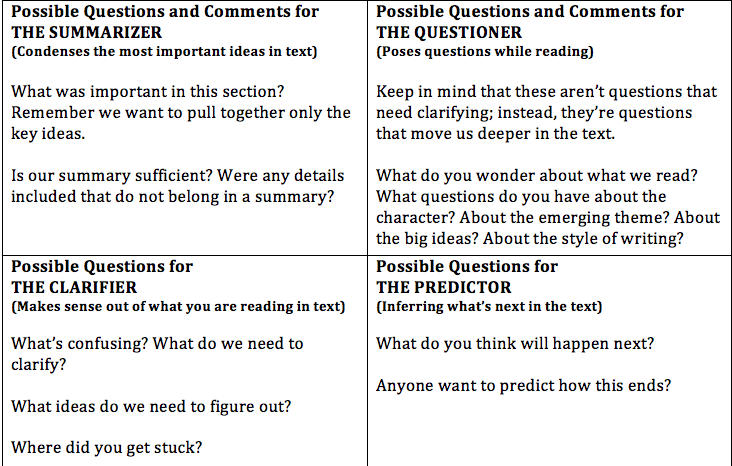
But first, students need to understand the sources. Eighteenth century writing style is very different from 21st century (especially digital and social media) writing style. Sentences are long; grammatical constructs are complicated; they use big words! Our eighth graders will struggle to understand the writing. This is why we are going to use Reading Workshop (mini-lessons on how to read informational text) and Reciprocal Teaching, a strategy we learned from visiting consultant Stevi Quate, to help them learn to read difficult texts. Groups of four students assume roles, and they tackle small chunks of the text together. Roles are rotated with each document, so students get practice with each type of thinking. Here is a "cheat sheet" we'll give students to help them get started:

There are four primary source documents in What Did the Great Awakening Awaken? That gives each student a chance to try out each role. By practicing this kind of thinking in a very structured, supported way, students will begin to internalize the strategies, and move closer to being able to read difficult texts independently. We'll see how well they do, and reassess how much scaffolding they need for our next Debating the Documents packet: Patriots and Loyalists. We may need to stay here for a while, or possible back off to pairs (each student gets two roles). By the time of the assessment, they should be able to tackle a text independently. But that's way down the road.