Welcome to Pohl Vault, a collection of reflections on being a middle school language arts & social studies teacher.

December 14, 2013

Critical Reading and Primary Source Documents in Social Studies

I have been doing a lot of thinking about reading instruction within Social Studies this year. This is partly due to the course I did over the summer, Harnessing the Common Core to Achieve Higher Levels of Reading and Writing (Heinemann), as I dug into the CCSS informational reading standards. This is partly due to dissatisfaction with my students' abilities to unpack meaning in a primary source document or a news article. And this is partly due to recognizing the need to bring in more supplementary resources instead of relying so much on the textbook.  

To this end, I have taught my kids how to annotate texts based on Cris Tovani's work (see my post Annotations as Assessment). They have annotated Q & A articles about Native Americans from Do All Indians Live in Teepees? (Smithsonian, 2012) and an article from the Washington Post about new anthropological evidence from Jamestown. I taught a week of lessons on reading informational texts using the TCRWP text set resource "Christopher Columbus: Who Really Discovered America?" And most recently, we had a guided unit on The Historian's Process in which students read and analyzed primary and secondary sources, both visual and written, to validate or invalidate historical questions about the early English colonies.

They are making progress However, primary source documents are difficult to understand for grade 8 students. The spelling catches them right away, and it is hard for them to get past non-standard English spelling to the meaning behind it. They use really long sentences, and each phrase is a meaning-packed unit all on its own. This can be exhausting for modern readers who are used to short, clear sentences. Finally, they use big words, or unfamiliar words. I am continuously surprised by the words they circle in their annotations with "What does this mean?" written in the margin. We need to do more context clue and word analysis work.


Usually at this point in the curriculum I turn away from the primary source focus and get back to role play and textbook reading. However, this year, I want to keep going with it. Fortunately, I found what I was looking for in my Social Studies closet: Colonial America: Debating the Documents (Social Studies School Services). This handy resources sets up 9 different debatable questions around topics related to Colonial America. A few topics are now too old to return to, such as the Pilgrims and Anne Hutchinson, but there are three that fit right in with what we will be discussing next: The Great Awakening, Loyalists and Patriots, and The Declaration of Independence. 
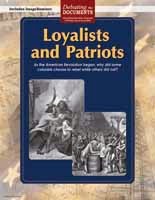
Each 4-5 day mini-unit presents primary source documents, both visual and written excerpts, that consider opposing sides of a question. Students are guided through these by looking at two to three short primary sources, answering guided questions about them, and then choosing between two as the one that historians would find most useful (with justification). This is repeated with two to three more primary sources. Next, students are assigned a "side" in the argument and debate using the documents as evidence. The final step is to answer the Document Based Question (DBQ) in a formal essay.


My teaching partner and I want to use the Great Awakening unit to introduce them to the process and do more work with reading skills. They will debate using a basic format used previously with the Columbus text set, but will not write the DBQ essay. Next, after role playing the First and Second Continental Congress, we'll re-teach and/or extend reading skill lessons and give them more independence in the Loyalist and Patriots unit, ending with a more formal and complex debate. Finally, the Declaration of Independence will be much more independent, ending with the DBQ essay as a summative assessment.

I hope three units is not too much. I don't want them to burn out on primary source documents or debates. Rather, I want them to feel comfortable and stop feeling intimidated by the formal language and difficult words. I want them to view a text and ask questions about its creator and the time period in which it was created. I want them to bring a critical, historian's eye to primary source documents and, in a best case scenario, to all texts they encounter in the world.

December 7, 2013

Reaping the Rewards of the Sprialed Curriculum

We launched into our short story writing unit yesterday. As my teaching partner and I were reviewing the unit earlier in the week, we had a pause and reflect moment. We realized three important things that impacted our planning:

  1. Our students have been writing realistic fiction stories every year since third grade.
  2. According to their personal narratives earlier in the year, they are good storytellers-- focusing in on moments, using dialogue and description to show, not tell, and developing one character.
  3. They are fanatics about fantasy books, especially dystopian science fiction and modern mythology.
And so we turned to the Grade 8 Curricular Plan for Writing Workshop (Calkins & TCRWP, Heinemann, 2011) and its Fantasy Writing Unit to modify our realistic fiction unit into a fantasy unit. This propelled us to consider lessons about making fantasy settings realistic (or at least believable), introducing magic early in the story so that the amazing object or power that saves the day doesn't come
out of the blue, and keeping tight control over the length and focus of the plot. It also sent us back to our bookshelves to find mentor texts that are short and highlight the teaching point within the fantasy genre. It was a bit of a scramble because of the narrow time frame we'd given ourselves, but it was worth it when I heard the loud cheer that greeted the announcement, "We're writing fantasy this year!"

Four years ago, when our group went to the TCRWP Writing Institute, we were just developing the genre-based unit spiral in middle school. The elementary school was only about a year ahead of us with implementing the TCRWP Units of Study in Writing, so our students coming into middle school were also new to the spiral. As we looked over the middle school units, which included historical fiction in grades six and seven, and fantasy in grade eight, we knew our kids just weren't ready for them. Nor were we. We agreed to stick to realistic fiction, also units in the grades six and seven curricula, so that our kids could solidify the short story fiction genre.

This year we get to reap the rewards of the spiralled curriculum. Our kids, and we teachers, are ready for the new and exciting challenge of fantasy writing. We will build on the solid base the students already have as fiction writers, inserting new twists to an established skill set. We will add scaffolds and reteach previous grades' lessons for those who have not yet reached the level of the rest of the class, either because of development or because they are new to our school. And we will open up the world of imagination to a group who is steeped in futuristic settings, magical worlds, mythological creatures, and sophisticated issues of tyranny, power struggles, discrimination, and environmental collapse. I can't wait to see what they come up with!

December 2, 2013

Book Ladders Part III

Here it is, December already. Nearly half the school year has passed. In that time, we have made some progress with our classroom library/book ladder/text complexity project. Here's an update:

  • Only 3 of the 6 of us chose this work as our professional goal this year. Two others wanted to dig into our new school-wide communication and grading system, Veracross. One other wanted to start a blog after going to a tech conference. I have to admit that I am disappointed. Without a departmental goal that all can work with, we have lost a lot of cohesion. 
  • The grades 7 and 8 classroom libraries have been inventoried and leveled. Except for my own inventory, which I did myself, our Teaching Assistant tackled that job. There are holes and errors, which teachers are just now discovering, but it definitely saved hours of their time to have her do it.
  • We downloaded the book lists from the Teacher's College Reading and Writing Project site. Each genre or thematic list is arranged with titles from most simple to most complex within a leveling system, first the guided reading A-Z system, and then the Lexile system. 
  • We highlighted the books we already have on that list (well, our TA did that part too, again with some holes and errors but still worth it).
  • Since it is ordering time, we ordered books that fell between our current books on the list to fill out book ladders for next year.
  • From the current and order list, we created a couple of book ladders that reflect the books in our classroom libraries.
I want to talk about that process a little bit. The TCRWP Fantasy book list is a long one that jumbles all kinds of fantasy together, from classic fantasy books like Eregon, to paranormal fantasy like City of Bones, to science fiction like Divergent. This made putting a book ladder together using just the TC list difficult and confusing, especially since kids tend to stick to one sub-genre for a while.

So on our Professional Development Day last week, the three of us sat down in my classroom to make a dystopian novel book ladder. This is a genre that many of our kids are reading right now, and we share a lot of the same titles on our shelves. It seemed a logical place to start.

Image found on olx.in website
With the classroom library inventory opened on our computers, we pulled as many science fiction dystopian books that we knew off the shelf and piled them on a table (there are probably more, but I haven't read all the books on my shelf yet!). Then we got sticky notes and we labeled the books based on our inventory's leveling information. Sometimes that level was a guided reading letter (T-Z), sometimes it was a Lexile score (usually between 650-850), and sometimes both.

Because we are hands-on, visual people, we lined up the books that had letter levels first, from easiest to hardest. Next, we slipped the Lexiled books into the line where they seemed to fit. Then we took a step back and frowned. Should the Shadow Children series (level Z) (e.g., Among the Hidden) be higher than Insurgent (Lexile 710) just because it has a dystopian theme? Considering length alone, the Divergent series seemed more challenging, as well as having a more complex plot and more complex characters. And what about Gone (Lexile 620)? It's a massively thick book, but not a complex storyline. Is there more to think about, infer, and discuss in Among the Hidden than Gone? We thought so, and put it behind the Shadow Children books.

In the end, we had a line-up we could live with. Next, we put together book labels for the backs of the books. These said: "If you liked this book, try (the next book in the series, or the next one up the ladder). If this book was not right for you, try (the next one down the ladder or one that is similar in level)." We felt this could give students more self-sufficiency as well as "save face" if they were reading low on the ladder.

Although we had a 3-hour chunk of time to work on this, we only got the one dystopian book ladder done. However, I think we needed to figure out what we were doing and how we would do it before we could get started. Now that we have done the one, we can go on and do others. I think I'll do the Social Justice book lists next, since we just finished that theme in our novel book club unit. Exciting!

November 2, 2013

How Curriculum Implementation is Like Ziplining

Forgive my absence last week. I was one of 12 adults who took 87 eighth graders to Chiang Mai, Thailand for Week Without Walls. It was quite the busy week: Thai cooking class, elephant conservation center, chatting with Buddhist monks, ziplining through the rainforest, a service project to paint a local kindergarten, a hike up to a rural Karen hill tribe village, sleeping in a dorm with girls who are afraid of bugs, a service project to plant vegetables for the village school lunches, and bamboo rafting down the river. Exhausting, yes, but also a great learning experience for everyone.

One element that I especially love about experiential learning opportunities is putting myself and the students in situations that push us out of our comfort zone. For the students, this uncomfortable feeling came at different points. For some, it was staying in a very basic dorm with thin foam mattresses on the floor instead of a 5-star hotel. For some, it was hiking on muddy trails up and down hills for three hours instead of driving or walking along flat sidewalks. For some, it was rolling paint on a wall, possibly the first time they ever participated in a DIY project. For me (and several others), it was conquering our fear of heights on the zipline.

As I've gotten older, my fear of heights has gotten worse. Last year, I didn't go on the zipline at all. That course had 27 ziplines with 5 vertical rappels/ abseils (I'm not sure which term to use). As the guide was describing the route, my face got whiter and whiter, my heart beat faster and faster, and I just couldn't start. This year, we went to a new place. This course had 26 stations which included 18 ziplines and 8 other ropes course challenges scattered throughout. I figured the variety of activities would give me a break from my terror. Besides, my chaperone group of eight girls needed me, especially the one who was as scared as I was. We made an agreement that we would try the first few together, knowing we could bail within the first six stations.

And so I started and it was scary and I clung to the rope that attached me to the line, eyes straight ahead, never looking down. As I passed the third one and then the fifth one, the zipline became easier and easier. I risked a glance at the forest floor 50 meters below me. I released a hand and made a silly face for the photographer. By the 26th station, I still wasn't comfortable, but the thrill was more pleasurable than terrifying.

Now that I am sitting in my living room looking back, I realize that the zipline lesson works for most risk-taking opportunities. I think back to four years ago when our middle school launched the workshop approach in English Language Arts. Many teachers were very uncomfortable with the model, especially the amount of unstructured independent time involved and the intense conferring element. However, we broke it down into smaller areas to tackle. Just like my agreement with the other scared girl in my group, we agreed to give it a try, focusing on the next tree ahead instead of the 26 stations ahead. With workshop, our department started with minilessons, a structure we could understand how to modify. As that became more comfortable, we began trying a few more things: meeting with each student individually at least twice per three week unit, developing small groups based on MAP data, observing each other to build our repertoire of management strategies and routines, matching books with students to increase their reading volume. And here we are four years later, with smooth workshops up and running. As you can see in my picture, I am still gripping that rope with one hand, just like many of us are still clinging to some structures that we just can't release yet. But we'll get there with practice, one zipline challenge at a time.

Can we do the same with the Common Core?

October 19, 2013

Using Formative Assessments to Improve Lit Essay Writing

We are required, as part of our curriculum, to give a core assessment at the beginning and at the end of the year. This core assessment is supposed to show growth in the subject, and is used as one data point along with standardized testing (when available) and in-class unit assessments. For the English Language Arts curriculum, we ask students to read a short story and write a literary essay about it. We use the same Six Traits literary essay rubric that we use during our Lit Essay unit. For the past several years that I've been doing this, I whipped through the scoring, knowing that the students weren't going to see or use the information until the end of the year when they did a reflection about their growth as writers. I scored the essays for the data point they were, trying to minimize the time commitment they required of me.

And then I read this article by Nancy Frey and Doug Fisher in English Journal, "A Formative Assessment System for Writing Improvement" (103.1, 2013, 66-71). Frey and Fisher advocate for a documentation system in which errors on a piece of writing done early in the unit can be clustered together by type, and then follow-up instruction is easy to organize and implement. They provided an example chart that made their system clear. Their point is that spending time assessing, and then instructing based on the information gleaned, early in the writing process will improve student writing much more than the red ink explosion we often expend on the final piece and which students generally ignore.

This is certainly not a new idea to me, more like review than an "ah ha!" moment. However, sometimes these reminders come at exactly the right time to change my habits. This was one of those times. I was just about to sit down to score my core assessment literary essays. And we are in the early stages of our lit essay unit.

So using Frey and Fisher's example chart as a model, I made the left-hand column of my error analysis chart reflect the main points from the literary essay rubric (see below). As I scored the essays, I found I needed some sub-categories to be more specific about the types of errors I was seeing. I included these sub-categories in the right-hand column, along with the students' names that needed support with that particular skill (I removed the names before posting to preserve anonymity).


Error
Class 1
Introduction includes thesis statement that alerts reader to upcoming argument
No thesis:
Expand:
No intro:
Topic sentences link thesis to paragraph content
Topic sentence wording:
No topic sentences:
Body paragraphs connected to thesis:
Conclusion summarizes main ideas and includes a reflection/insight
No conclusion:
Reflection:
Idea is supported by text evidence (quote or paraphrase)
Quotes:
Paraphrase:
Evidence supports topic sent/thesis:
All parts of text:
Text evidence is explained for significance

Literary and academic words are used formally
precise words:
Vocabulary building:
Formal:
Sentences are fluent and grammatically correct
choppy sentences:
concise:
Verb tense shifting:
Subject-verb/adjective-noun agreement:
Quotes are punctuated and cited correctly, including quoted dialogue

End punctuation is correct

end punctuation and comma splices:
Clauses as sentences:
Editing tool used effectively
spell & grammar check:

Next, I looked at areas where a large number (a third or more of the class) had difficulty, and decided to make those whole-class lessons. For example, punctuating and citing quotes correctly is a skill that nearly half the class has not yet mastered. This will become a whole-class lesson. I will also do a whole-class lesson on introductions and conclusions. Since our 8th grade lit essay is focused on comparing two texts, a new structure for middle schoolers, having an introduction that sets up the structure for the reader, and a conclusion that goes beyond summary to a more generalized idea, are lessons everyone can learn. Within those whole-class lessons, though, I can still check in with individuals or small groups who need further scaffolding during conferring time. 

This system took about twice as much time as I normally spend with the core assessments. However, I think it is worth it so that my students can get targeted instruction that meets their writing needs when they will actually use it. Frey and Fisher suggest that time spent assessing early in the process means that teachers need less time assessing at the end of the process because we have already made our suggestions and recommendations. That makes sense too. 

Our next writing unit is short fiction. I wonder if I can get a quick fiction piece-- a pre-assessment as it were-- from students about a week before the unit starts. Getting the unit started with formative information already in place can help me know how to help my writers improve every day of the unit.