Welcome to Pohl Vault, a collection of reflections on being a middle school language arts & social studies teacher.

January 10, 2015

Using Close Reading of Multiple Sources to Get Away from the "Single Story" of US History

Teaching history is the art of storytelling. But storytelling has its dangers, as Chimamanda Ngozi Adichie, author of my January adult book club book Americanah, warns in her TED talk "The Danger of a Single Story." She warns that only telling one story of a people leads to stereotyping and false assumptions, such as disregarding her Nigerian middle class upbringing as not "authentic", according to one of her American college professors, because it wasn't the starving/sick/poor/hard-scrabble story we Americans hear about Africans from our media. She asserts that only by telling multiple stories will we get the true meaning.

This idea of multiple stories, multiple sources, is a topic explored by Mary Janzen in her 6 Jan 2015  SmartBlog post "Using digital resources to enhance social studies, history instruction." She argues that the textbook version is too narrow, that it's the "single story", and that adding digital resources including many primary source documents, helps students to see history from multiple perspectives, without stereotyping or narrowing to only one story.

As we jump back into Early American History next week, my co-teacher and I are pushing pause before moving forward in the chronology. We finished our Colonial America unit right before the winter break, so we are going to linger for a couple weeks in some of the big ideas that formulate the Promise of America, our year-long theme. Many of the "promises" were formed during the colonial era: freedom of religion, self-governance, the free enterprise system, and equality (within contextual boundaries, of course).

One of the defining movements during the early 18th century was The Great Awakening, a time when itinerant Christian preachers spread ideas of breaking away from authoritarian religious practices, like the Puritans, and embracing the right to practice religion in a way that allows the common person to have a direct relation with God. A central tenant was that everyone is "equal" in the eyes of God, a very radical viewpoint for the times. Here is what the textbook closes its three paragraphs with: "By encouraging ideas of liberty, equality, and self-reliance, the Great Awakening helped pave the way for the American Revolution." (TCI, 2011).

So that's the single story: Preachers preached, people converted to their ideas, and the American Revolution was born. Hold on... we all know it's not that simple.

We are going to use the resource What Did the Great Awakening Awaken? (Social Studies School Services, 2007), a collection of primary source documents, both visual and written, that presents two sides of the story: the religious revivalists and the authoritarian establishment. It is set up to be used as a DBQ (Document-Based Question), with guided reading questions to scaffold understanding the documents before answering the question: "'The Great Awakening taught colonial Americans to challenge religious authority forcefully. This helped prepare them for the political revolution to come.' Assess the validity of this statement." However, instead of asking students to write a DBQ essay, we're going to hold a debate. This will build on our previous work with finding evidence, stating a rule, and drawing a conclusion (see previous post on this). Students will need to draw evidence from the primary sources to use in their debate argument, and justify their thinking with the rules and conclusions.

But first, students need to understand the sources. Eighteenth century writing style is very different from 21st century (especially digital and social media) writing style. Sentences are long; grammatical constructs are complicated; they use big words! Our eighth graders will struggle to understand the writing. This is why we are going to use Reading Workshop (mini-lessons on how to read informational text) and Reciprocal Teaching, a strategy we learned from visiting consultant Stevi Quate, to help them learn to read difficult texts. Groups of four students assume roles, and they tackle small chunks of the text together. Roles are rotated with each document, so students get practice with each type of thinking. Here is a "cheat sheet" we'll give students to help them get started:
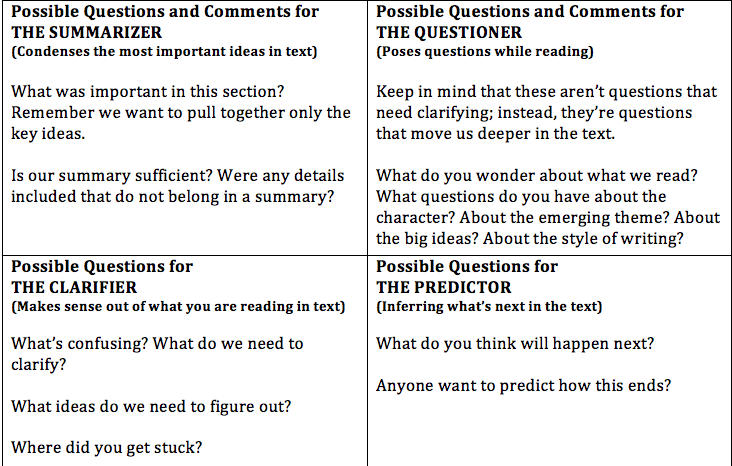
There are four primary source documents in What Did the Great Awakening Awaken? That gives each student a chance to try out each role. By practicing this kind of thinking in a very structured, supported way, students will begin to internalize the strategies, and move closer to being able to read difficult texts independently. We'll see how well they do, and reassess how much scaffolding they need for our next Debating the Documents packet: Patriots and Loyalists. We may need to stay here for a while, or possible back off to pairs (each student gets two roles). By the time of the assessment, they should be able to tackle a text independently. But that's way down the road.

December 27, 2014

Learning About Fantasy Writing with Eragon

Winter break fell smack-dab in the middle of the fantasy writing unit. I am taking advantage of this opportunity (look at the sunny side!) by asking students to read a fantasy book by the end of the break in order to keep their minds on the genre. When we return, I'll ask them to do some reflection on their reading based on the genre definition we constructed at the beginning of the unit. Then I'll have them apply those ideas to their fantasy story drafts to ensure they are writing in the genre. 

image from Amazon.com
In keeping with my do-what-the-students-do philosophy of teaching reading and writing, I am reading fantasy over the break. I picked Eragon by Christopher Paolini, a book I have heard about for years from students and my own children, but one which I haven't felt motivated to read. At nearly 500 pages, I knew it would take me some time and stamina to get through it. Besides, I am a little tired of the traditional magical fantasy genre-- after Lord of the Rings, what else is there to the hero's quest story? 

But if I only read young adult books that I knew I'd like, I would be missing a huge opportunity to connect with students who like to read other things (like quest-based magical fantasy books). So I packed it into my backpack along with my journal as I set off for my winter break travels. 

One week later, and I'm on page 440. Here are some things that I noticed about Eragon as a fantasy book (spoiler alert-- I may have to reveal certain plot events to make my point):
Luke & Obi Wan from pinterest

  • Eragon and Brom are like Luke Skywalker and Obi Wan Kenobi (Star Wars): novice and master, orphan and substitute father figure, novice thrust into adulthood before he's ready when the master dies.
  • Eragon and Murtagh are like Frodo Baggins and Aragorn (AKA Strider) (Lord of the Rings): The young hero is suspicious of the unknown and seemingly dangerous stranger at first, but is in a situation where he must rely on him for survival and help. As they journey together, they learn trust and respect, even brotherhood.
    Aragorn from wikipedia.com
  • The idea that True Names have power (every being has a True Name which is not the everyday name that is used in the world-- when one knows another's True Name, they can control the other) is in a lot of books, but I think Ursula K. LeGuin did it first in her short story "The Rule of Names". 
  • Dragons and Dragon Riders communicate telepathically was seen in Anne McCaffrey's Dragonrider series. It is a convenient device, however, so that Eragon and Saphira can "talk" things through without those around them listening in on their conversation. 
  • Eragon's world is like medieval times, a common fantasy setting. People ride horses as transportation, the cities are filthy with no modern conveniences, food is meat cooked over fires and bread with few vegetables, weapons are swords and knives and bows & arrows (and magic). 
  • Anything goes. I guess this is a basic tenant of fantasy. Eragon becomes an amazing swordsman in mere months. He learns magic and is incredibly powerful with very little training. He and one other defeat deadly fierce Urgal creatures with only bruises and scrapes to show for it, although they are outnumbered. The good guys show up to rescue them just in the nick of time! Whew! Eragon meets the girl of his dreams (literally) after only a short search.
I am not sure how all these noticings will help my short story. I guess the message is that it's OK to borrow elements from other texts as long as they are remolded into your own story. After all, the stories we are writing during our writing unit are a way to practice narrative writing techniques. The goal is not to be the most creative or original with our ideas. If a young writer (or an old one like me, but one who needs the scaffold) needs to start with a familiar plot line, that's OK. We are still learning how to do all those other narrative things like writing dialogue that reveals character traits, and structuring the plot either chronologically or with flashbacks, and using inner thinking to help get the message of the story through to the reader. If, along the way, a creative and unique idea emerges, then that's cause for celebration and wonder! 

December 13, 2014

Musical Jingles as a Social Studies Presentation Tool

One of the things I like about the Teacher's Curriculum Institute (TCI) materials is that it suggests brain-based learning activities that are developmentally appropriate. One of my favorites is the Colonial Fair: students promote their colony to prospective immigrants. Students in teams of 4 (ish) design a poster that includes labelled visuals of at least 4 of their colony's best features and includes a slogan, they write a sales pitch, and they write a jingle which they have to sing during the fair. Although students hate that it is low-tech ("There weren't any computers in 1700! You know what an ear of corn looks like; you don't need to look it up on Google Images to be able to draw it!"), I love that they are using so many modalities to manipulate the information.

During the Colonial Fair, the groups split into two teams: one stays, the other strays (one team presents, while the other team visits the other booths), and then they switch. Visitors have a rating sheet with them so they can rate each colony for how enticing it is: 5) Leaving Today!, 4) Saving Money for the Trip, 3) Choice Between Paris and Here-- Can't Decide!, 2) Going to the Beach Instead, or 1) Staying Home and Reading a Good Book (thanks to Lee Piscionari for the rating sheet!).

Once everyone has visited the booths, they answer this question in writing: Based on your experience at the Colonial Fair, which colony would you want to move to and why (provide at least 3 reasons)? I do a quick share-out as one last review opportunity.

Fun, right? And a great brain-based multi-modality learning activity!

One of the hardest parts for students in past years has been the jingle. They just didn't really get what a jingle would include or how to write one. I was thinking about this when I stumbled upon Mr. Betts' Class historical song parodies. The original one I stumbled upon was 'What Does John Locke Say?' (based on "What Does the Fox Say?"), but then I noticed titles that related to the work we were doing with the colonies: "Moving to the Colonies (Miley Cyrus/ 13 Colonies Parody)" and "Pennsylvania: The Quaker's Delight (The Lion King Parody)". Aha! This would be a great way to introduce the jingle concept!

The results were magnificent! Here are some favorites:

Pennsylvania [To the tune of "Call Me Maybe"]
I moved to Pennsylvania
I have more pay and more rights
Now I can say what I feel
I truly love my life
We're treated fairly now
and with religious freedom
where you are equal as well
I was searching for this
So come and join us
Live free
be accepted
the forests
and hills call you
so come and join us here maybe
Hey I just met you
And this is crazy
but live here with me
we can be wealthy
It's hard to think of life not like this
so live here with me
we all have freedom
we don't support war
and love equality
we farm and lumber
or we build ships
unless we're merchants
or trade with tradesman
(and it goes on for 6 more verses!)
Virginia [To the tune of "Rude"] 
Hey, it's Virginia, we are the first
successful English Settlement
Our religion is Anglican and we pray
in the Church of England
Our winters are cold but they're not that bad
Our summers are ho-o-ot
We're self-governing with elected assembly
     (House of Burgesses)
Our economy is farming, plantations, and small independent farms
but there's more
    (to talk about)
Our settlement thrives on the sale of tobacco because there's
a lot of land and there's more to plant
Come on and move to Virginia!
New York [To the tune of "Lazy Song"]
Today I just landed in New York colony
I just want to earn some money
I bet you didn't know we were named after the Duke of York
Cause he gave us a lot of land for this colony
We have religious freedom and that's a good thing
We gotta ton of jobs for you and the fam
Too bad for the settlement of New Amsterdam
Oh yes I said it! I said it, I said it cause I can
New York is the best colony over here
(whistle) 
Hahahaha! I love it! I think I will dip into more Mr. Betts' Class parodies as we move onto other topics. It definitely got the students engaged and thinking about how to communicate the essentials of their information in a new way. I wonder what they'll come up with for The Constitution?

December 6, 2014

Teaching Argument Through Primary Source Evidence

A couple of weeks ago, a literacy consultant, Stevi Quate, came to our school to work with the middle and high school teachers. Our Director of Curriculum and Professional Development invited her, knowing that the English departments at both levels were implementing the CCSS, as had the Math departments, and that Social Studies and Science were soon to follow. Literacy is a big push for all those subjects in the CCSS, and Stevi would be a great jump-start into improving our practice.

Stevi sat down with my co-teacher and me one morning to help us think through improving argument skills in eighth grade Social Studies: Early American History. One of our big units of the year is The Road to Revolution, during which students take on the role of a historical Patriot or Loyalist, and debate, during a series of Town Hall meetings, the issue of rebellion. Over the past few years, the results have been something like this: "Um, so I think we should rebel because, you know, the Stamp Act was really unfair." "Yeah, me too. The Stamp Act and the Quartering Act." (Etc.) Uninspired, mindless repetition of textbook content.

Stevi introduced us to the work of George Hillocks, Jr., and his text Teaching Argument Writing, Grades 6-12 (Heinemann, 2011). In the sample first chapter, Hillocks demonstrates his methodology for teaching students how to notice evidence, explain the "rule" (he also calls it "warrant"), and draw conclusions. He uses crime mysteries-- narrative plus illustration-- as his hook to teach the skills. He asks the question: "Is Queenie (the victim's wife) telling the truth?" Then he walks students through the deductive reasoning process.
Chart adapted from Hillocks, 2011.
We just finished two big writing units: Literary Essay (use evidence to support an idea) and Investigative Journalism (find out evidence to help you explain an idea). We also did some work with "The Historian's Process": using primary and secondary sources to draw conclusions about historical events. This Hillocks method seemed like a very natural next step to develop arguments and do even better work with primary source documents. As you know, I am a great believer in adopting/adapting good ideas.

My co-teacher and I decided that the crime mystery in Hillocks' chapter would not be a good fit for our community. Besides, I like practicing skills on things that are actually part of the curriculum; it's a two-for-one kind of a thing. So we decided to use the primary and secondary source materials from our next Social Studies chapter, Life in the Colonies (US Through Industrialism, TCI, 2011) as the texts to use for learning deductive reasoning skills.

The textbook activity directions say: "Acting as investigative journalists, you and your partner will investigate life in the American colonies. You will travel to eight places to examine primary and secondary sources and uncover the truth about what life was really like in the colonies." Each "place" has a visual and a written document, and a "headline" (fictionally) published in the English press about what life was like in the colonies.

To introduce the students to Hillocks' method, I will show them a 3-minute clip from the BBC show Sherlock, in which Sherlock Holmes, "consulting detective", explains to his new room mate, Dr. John Watson, how he knew so much about him when they first met. In his explanation, Sherlock names the detail he noticed (for example, Watson's haircut and stance), explains why it is important (suggests time in the military), and draws a conclusion (combined with his tan line, it could only mean he was serving overseas: in Afghanistan or Iraq). This engaging clip, combined with their recent work as "investigative journalists" and "historians", will lead us into the day's work.

Using the Gradual Release of Responsibility method (basically, workshop minilessons), I constructed a slideshow so that I could model the technique, have students try it out with my guidance, and eventually release them to do the work on their own. With each source and using the form above, students have to find evidence, the rule (why the evidence is important), and draw a conclusion about how accurate the (fake) English headline is. Students will need 3-5 pieces of evidence before they can confidently "prove" that the headline is either true or false. I will go through at least one visual and one written source to model/practice. Here is a sample visual slide:
Image by Janet Pohl adapted from TCI, 2011 and G. Hillocks, Jr.
The important part of this process, and what has been missing from my previous instruction, is the "rule" (or "warrant"). Students were giving evidence without explaining why it was important or how it proved anything. In their literary essays, we did some work on this using sentence starters like "This illustrates...", "This shows...", "This is important because...", "This connects to .... because...", and "Consequently...". If students can transfer some of that language and thinking into their Social Studies debate skills, their debates will be much better. So will their constructed answers on tests, and on future essays.

The next part of this process will be to teach them how to prove their point with logic, and, even more difficult, how to pick apart someone else's argument. But that's for another blog.

November 29, 2014

Investigative Journalism: an Integrated (?) Unit

"Let's do an integrated unit together," my math/science colleague suggested when he returned from the NSTA conference in Boston last spring.

"Uhh, OK. On what?" I tentatively replied, thinking about my Early US History Social Studies curriculum. Where's the science in that? What could he do in science related to my SS units?

"I could teach the science content and you could teach the writing part of a project!" he replied. He was very excited, fired up from a workshop that encouraged writing in the disciplines-- probably Common Core related.

Immediately, my chock-a-block ELA curriculum flashed in front of me. There was no wiggle room to add an integrated project. And besides, what did that mean anyway: I would teach the writing? What would it be? Who would grade it? I already have more writing to grade than time needed! And why couldn't he teach the writing in the discipline? Isn't that the direction that Common Core is nudging us?

"Well, maybe we could do something around Week Without Walls," I countered. This was the only wiggle room in either curriculum-- an undefined something related to our eighth grade trip to Thailand. Over the past years, the WWW project has taken many forms (sometimes so formless it was non existent), with a tenuous link to the SS curriculum via a "Global Citizenship" benchmark. 

"I was thinking I would move the Environmental Science unit to the beginning of the year. That could be our WWW content, environmental issues." I liked the idea of an environmental focus for the trip; we do a lot of activities related to the natural environment while in Thailand. We agreed we would discuss it further when school started up again in the fall.
image of elephant conservatory by Janet Pohl (author)
But it was not exactly on my radar as school started in August. We were tasked with implementing the new CCSS English standards, and we were handed the Calkins et. al.'s Units of Study in Writing as a resource. As a department, we started the year with a flurry of unpacking standards, adjusting writing units, exploring new rubrics, and closely reading the densely-written Units of Study. We were about two days ahead of the students. 

Meanwhile, back in science, my colleague was happily going about his Environmental Science unit. A month or so before our trip, I finally had the head space to talk with him about his integration idea. I learned that his unit would be finished about a week before the trip. Students focused on 5 different environmental issues each: what they were, how they were caused, and some solutions. None of the research about issues was specific to Thailand. Take it away, ELA/SS!

After a weekend of wondering how this was at all integrated-- after all, I was taking on the responsibility of continuing the authentic science writing product and science took on nothing of my curriculum, I decided to look on this as an opportunity. The one unit in the new Units of Study in Writing that puzzled me the most was the Investigative Journalism unit (how is that narrative?). Since the content of this WWW piece was securely on the shoulders of science, I could focus completely on the process of writing a new genre. Surely we could use the environmental issues as a content base and build in "field research" from our trip to write in an authentic journalistic style.

image of Chedi Luang Temple by janet Pohl (author)
I looked for models in the world, and found that Time for Kids has very accessible articles about science topics which would match the kind of writing I wanted from my students. I considered what topic I would use when I was modeling lessons, and decided against an environmental issue (I didn't want to do someone's work for them). Instead, I focused on Buddhist monks in Thailand; we visit a temple and participate in a "monk chat" while in Chiang Mai, and selecting Buddhist monks as a topic allowed me to introduce background information to students before we went. The issue? It turns out that the number of monks in Thailand is rapidly decreasing because the economic boom and falling population rates have drawn men away from the traditional commitment of ordination. Oh, and did I mention "Global Citizenship"?

I spent the first day expanding their Google search skills so that they could find relevant, readable, reliable sources about how their issue related to Thailand. Then I got them taking notes in the "5 W's" structure (who, what, where, why, when, and how), which they had to summarize in a "lean" or "dramatic" journalistic style to synthesize the information and to practice the new writing style. I left them to continue researching at home, and turned the lessons over to writing up the general science information in a "background information" way, incorporating their Thailand research when they were ready. Before leaving on the trip, we worked on interview questions-- they were required to take pictures and interview at least one person about their issue while they were there. This was the "field research" part.

Once we returned, lessons centered on incorporating the interview, writing leads that hooked readers, and writing endings that left readers with something specific to do to help solve the problem. We discussed headlines and always always focused on meaning-- What is the message you want your readers to understand when they finish reading your article? Finally, we made e-zines and students made their pages for their articles. More tech lessons helped them understand layout options, citing and usage rights with images, embedding pictures and slideshows, and hyperlinking to organizations related to their issue. Several rounds of peer review took place-- remember, the world will be reading this! You want to look as smart on paper as you are!

For a giant experiment all around, the e-zines turned out well. Students worked hard to make them attractive and engaging. Of course, the articles have a variety of proficiency, as the writers themselves do. They are eighth graders, after all.

Next year, I would like the science teacher to take on the Thailand research link, and to help grade the content part of the article. That would make it a little more integrated (and fairer) in my view. Overall, though, I like the project and the writing genre, and it made the students view Thailand with more than tourist eyes. It was also a way to get more writing into the year, and in a fresh, new genre. There's a lot of good in that!