Welcome to Pohl Vault, a collection of reflections on being a middle school language arts & social studies teacher.
Showing posts with label talk. Show all posts

August 27, 2016

Holding kids accountable to home reading: Reading logs?

To use reading logs or not to use reading logs? That is the question! 

Our middle school English Language Arts program has a commitment to lifelong reading habits, which means that we expect students to have a book going at home at all times throughout the year. We are also committed to holding kids accountable for that reading, because we know that our reluctant readers need some kind of accountability system to keep them going. What that accountability system looks like varies from grade to grade, and even from classroom to classroom. 

Over the years, we 8th grade teachers have tried many things, but we've always started the year with paper reading logs that track daily reading statistics, and a weekly reading response. Based on the Teacher's College Reading and Writing Project's (TCRWP) recommendation, reading logs that track title, author, time of day, number of minutes, and number of pages read each day can become a data source for students to reflect on themselves as readers. Am I only reading at night and falling asleep with my book? Is that the best time to do active reading? Do I read in 5 or 10 minute bursts, when I'm in the car or waiting for the bus? Do I wait until the weekend and read for long stretches of time but don't read during the school week? Am I reading at a good pace, or am I slow (is my book too hard?) or fast (is my book too easy?)? How do I want to improve as a reader?

We only ask for the daily log to be completed for a limited time-- usually during the first couple months of school. During those first months, students do some analysis to look at their reading habits and evaluate how well they are meeting their goals. Later, we back off and ask students to track number of minutes and number of pages read each week, which they report along with their weekly reading response.

Here's the thing: Kids HATE reading logs! The good readers hate them because they just want to immerse themselves in their reading and not bother with tracking their minutes and pages. The struggling readers hate them because it's tedious and it shows that they aren't actually doing the reading they are supposed to. Mostly, it just seems like busywork without purpose. 

This led my colleague and me to really re-think reading logs this year. Something needed to change. Either we make the value of reading logs clearer to students (as TCRWP explains, just like athletes keep stats to find what's working and what needs improvement, so can readers use these stats to become better readers), or we find another way to hold students accountable for their reading. 

That thinking led us to this question: What do adult readers do when they want to have an active reading life? As active adult readers, here is what we do:
  • We keep track of the books we read on a social media site (I use Goodreads). I post up a book when I start it, and then review it when I finish it.

  • We talk about the books we read with others. I have been a member of an adult book club for almost 20 years. Knowing that I have to discuss a particular book on a particular day (and have something to say about it) holds me accountable to reading and thinking about that book.
  • We get suggestions for our next reads from friends, through social media (like Goodreads) or from Amazon.com ("Customers who bought this item also bought..."), or by exploring more books by the same author.
Here is what we don't do: Keep a daily reading log, even a weekly reading log, of minutes and pages. We log the books we are reading as we change books. We are held accountable because we have people in our lives that follow our reading and talk to us about our books.

Yes, but... middle school students do need a little more accountability structure than I do as an adult reader with well established lifelong reading habits. Our compromise:
  1. Students need to read at least 100 minutes (about 100 pages) each week. They will need to track this somehow on their own. They can decide when those minutes happen, although I will recommend that it's not all one chunk of reading on the weekend (there is value to smaller but more frequent practice).
  2. They need to think about their reading, and show that thinking in a weekly reading response. I am afraid that waiting until the book is finished will result in very little writing about reading for reluctant readers. Writing weekly will keep them accountable for reporting their reading minutes/pages, and having to say something about what they read means they have to have read something. I will give them in-class time to complete this for the first month.
  3. Writing about reading is a pointless task unless you use it as a way to communicate your thinking to others. We are going to have kids get into small Reading Clubs (3-4 students) who will hold short book discussions on Thursdays. We'll ask them to write their response first, and then discuss their books with others. 
  4. Their written responses will be on Google docs, which they will share with members of their group (and me), so they can go back and see what they each read if they need a next book suggestion. We used to use Shelfari, which was a super easy and attractive platform, but they have merged with Goodreads and are not in use anymore. Goodreads is not very student friendly, and Google docs is familiar and easy for the kids because we use it all the time.
We are launching this next week. I hope the social aspect of Reading Clubs makes their home reading feel more fun and purposeful (and hold them accountable for doing their reading). I was reluctant to give up class time at first (so much to do! so little time!), but if I value the home reading program (which I do), then I should devote class time to it. We can ease off of weekly Reading Club time, and turn it into monthly Reading Club as habits get established. 

What do you do to hold kids accountable for reading at home? How do you track what and how much kids are reading? Do you use reading logs?

December 5, 2015

Using Technology to Grade Book Club Discussions

My school has taken the plunge into standards-based grading. Well, maybe I should say: my school has waded in up to its ankles into standards-based grading. We are grading and reporting on a small, manageable number of "categories" related to standards rather than each individual standard. For English Language Arts, we've chunked the standards into Reading, Writing, and Speaking & Listening (Language standards are incorporated under Reading and Writing). So far this semester I have given 3 Reading summative assessments, 1 Writing summative, and 0 Speaking & Listening assessments. 

Luckily, we are finishing our novel unit this week, which includes their third Book Club discussion. This seems like a perfect opportunity to grade Speaking & Listening standards! But without "fishbowling" six discussions (and taking 2 or 3 class periods to do so), how can I fairly assess each group? Getting around and listening to six discussions for 5-7 minutes each may not catch the normally quiet student who said all their "good stuff" while I was with another group. 

image from commons.wikimedia.com
Technology to the rescue! Students recorded their first two discussions using either QuickTime or Garage Band, and uploaded the audio file into a shared Google folder. Last year we tried using the Photo Booth app on their Macs, but the resulting video file was too large to upload. We discovered that audio files are smaller and easy to upload, and really it's the audio we want anyway. 

The first two discussions were formative. Students received the Book Club Discussion rubric before they began so they were aware of what would be assessed. As students discussed (and recorded), I walked around and spent a few minutes with about 4 groups. I coded the discussion so I could have a sense of how it was going: NT- New Topic, Add- Added to previous comment, TE- used Text Evidence, I- interruption, etc. 

If things seemed dire, I would interrupt and prompt the group; for example, "I've been sitting here for a few minutes, and I've already heard three new topics. See if you can stick with one discussion thread for longer so you can really dig deep into your ideas." Then I would listen for a few more minutes and see if they could make the correction. In all cases, before I left I would interrupt the discussion and give feedback to the group: "So here is what I heard while I was sitting here: 'A' started a new topic about ___, and then 'B' added on with some interpretation, and then 'C' brought in text evidence. This was a great way to keep the discussion going. I also noticed 'C' kept talking and never let 'D' have a chance. Make sure you are giving everyone equal air time. That's everyone's job to monitor. If you notice someone hasn't talked, be sure to invite them in. If you know you've already said a lot, hold your thought until others have a chance to speak. If you know you haven't said much, make sure your voice is heard-- you have important things to contribute!" When the discussion time was finished, the group rated themselves and others for the four categories of Prepared, Quality of Speaking, Quality of Listening, and Behavior. They then made a group goal for the next discussion. 

During the second discussion, they reviewed their goal, and repeated the process. I made sure I sat with the groups I hadn't seen the first round, and went back to those that had the most trouble previously. Again, groups recorded their discussion, rated themselves and others, and made a goal for their final one.

Now that students have had practice in recording (we had some tech issues to resolve the first time around), are familiar with the rubric because they used it for reflection and goal setting, and have gotten teacher and peer feedback, they should be ready for the final summative discussion. On Monday they will repeat the process just like they did the first two times. I will walk around, but I will not interrupt or give feedback this time. I want this to be independent, but I can also get info about body language, preparation (do they have their books and notebooks with them?), and behavior which the audio recordings may not pick up.  

Then I can sit down with their self-rated rubrics and listen to full discussions from the audio files. I will be able to catch the quiet kid who is reluctant to talk when I am sitting with the group. I can hear the "good stuff" come up and not just judge the bits and pieces I overhear for a few minutes. Technology allows me to be everywhere at once, which means I can grade each student fairly.

How do you grade Book Club discussions?


September 12, 2015

The Paradox of the Early Days: Building Trust and Respect

image from Uberallburo website
A few weeks ago, as summer was winding down and the new school year loomed, I came across this quote from Brenda Powers of Choice Literacy: "It’s a paradox that the early days of school fly by so quickly, yet it is still such slow, hard work to build trust and respect."

This resonated with me so much that I printed it out in large font on colored paper and pinned it to my (actual, real, physical) bulletin board by my desk as I started the year. I posted it because building trust and respect early in the year is such vital work, work that sets the tone for all other work for the rest of the year, and can easily get lost in the rush to jump into the business of curriculum. And I didn't want to forget to do it. 

Oh sure, the first week was full of get-to-know-you games and setting the expectations for all things school. But that's not enough. Here are some things I do to build classroom community throughout the first 6 weeks of the year:

image by hrlab
  1. Share, share, and more share. Yes, part of the workshop structure already includes share time. But early in the year, share time IS the work. Write a little, share. Read a little, share. Reflect a little, share. "Pair-share with your elbow partner" is easiest, but it's important to get kids to share with others that are not in their immediate friend circle if you want to build classroom community. Other structures are: share across the table, two members of a table switch with two members at another table, mingle with music and share with whoever is closest when the music stops, make an appointment calendar with four other people and share with one of them, whip around the room so that everyone shares one small thing, and of course the classic (but scary for most middle schoolers) whole class share.
  2. Reader-Writer Poster: Students make a poster introducing themselves as readers and writers. This includes a short About the Author bio, favorite quotes about reading and writing, an excerpt of a piece of recent writing, and 3 favorite books with blurbs and justification for inclusion. We do a gallery walk connection activity (another share!) where students look at each others' posters and have to find 4-6 commonalities between their own poster and others' posters (no repeats!). 
  3. Six-Word Memoir: Students think about how they can capture their life philosophy, their hopes for the year ahead, or their past into six words. After drafting a few possibilities, they pick their best one, write it on a colorful sentence strip and share with others (remember #1?). These are posted on the wall for the first few weeks.
  4. Writer's Workshop: I start the year in English Language Arts by launching Writer's Notebooks because we write about ourselves in our Notebooks, and then... yep, you guessed it, we share those stories with others! Students write memories, beliefs, entries about identity and pet peeves, important times in their lives, and rewrite earlier entries to practice craft. Although this is challenging for those students who are new to Writer's Notebooks, it is a great way to learn about each other through the first 3 weeks of school.
  5. Reader's Workshop: Although it is already week 4, we are still building community and trust. Students think about their reading identities and... share those identities with others. What books do you like? What reading habits do you have? When do you like to read? What books made an impact in your life? This sets us up for a year of independent reading and book conversations. Students find others who like the same kinds of books (even if they are not "friends" socially), so that they can get recommendations and share their reading life with others who can relate.
  6. Add in fun. Building community, trust and respect can be fun, and having fun together builds community. We know the get-to-know-you games during the first week are fun. But we often forget about fun after that. Share time is a great time to incorporate fun, even if it's just playing upbeat music while they talk. Get students out of their seats, have standing conferences instead of seated. Play rock-paper-scissors or a variation (I love gorilla-man-net instead) to see who goes first to share. Have kids high five or give an exploding fist bump after sharing as thanks to their partner. Build in stretch time after focused work by playing Simon Says. 
    image from Rizomatica website
English Language Arts is a scary place without trust and respect. I ask kids to write personal stories, take creative risks, bare their thinking, work collaboratively in groups. None of that important work will happen unless class is a safe place, not just with me, the teacher, but also with their peers. Building classroom community is important work early in the school year, and it takes time. Find the time, take the time, and your classroom will be a better place for it throughout the year.

February 21, 2015

Merging CCSS Social Studies/History Standards with Reciprocal Teaching

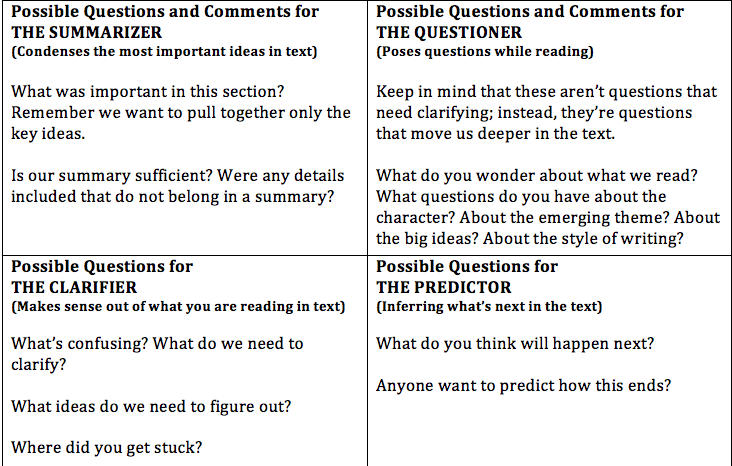
In my January post, Using Close Reading of Multiple Sources to Get Away from the "Single Story" of US History, I shared a scaffold I learned from Stevi Quate called Reciprocal Teaching. This scaffold assigns roles to students in groups of four: Summarizer, Clarifier, Questioner, and Predictor, as a way to help everyone in the group unpack complex texts. I used it with a packet of primary source materials about The Great Awakening, and noticed that students were getting a lot more out of the texts than previous classes had. 

Along the way, I added some minilessons aligned to the CCSS Literacy in Social Studies/History standards from the Teacher's College Reading and Writing Project as a way to build students' skills for reading informational texts. I connected those reading skill lessons to the Reciprocal Teaching roles: 
  • Clarifier (This role goes first after a chunk of text has been read): READING FOR KEY IDEAS AND DETAILS: Standard 1: Reading Closely and Making Logical Inferences: "Readers know that informational texts are conveying ideas, facts and examples. Our first job, then, is to make sure we read informational texts in a way that we can really “get” the information without veering off into personal connections or response. If we’ve done our job well, we should be able to turn around and teach someone else everything we’ve learned so far. We can do this by reading a short chunk of text, pausing, covering or looking away from the text, and trying to say back everything we’ve learned so far." 
  • Questioner (This role goes third): READING TO INTEGRATE KNOWLEDGE AND IDEAS AND THINK ACROSS INFORMATIONAL TEXTS: Standard 8: Evaluate Text Evidence, Weighing the Validity of Author's Claims: "Readers of informational texts consider how well an author has made his/her claim by taking a close look at the evidence used to support it. Readers ask ourselves questions like, 'How valid are the author’s claims? Is there enough evidence? Is the evidence good? Does it fit the claim and seem reasonable? Can I trust the source of the evidence? Has the author laid out the evidence in a logical manner that makes sense?”' 
  • Summarizer (This role goes last): READING FOR KEY IDEAS AND DETAILS: Standard 2: Determining Central Ideas or Themes: "Once readers really “get” the information in an informational text, their next job is to try to find the central, or big idea of the text. We do this by asking ourselves, “What is this text starting to be about?” We can think about all the details we’ve read about so far, and put them together to find the central idea. We remember to hold ourselves to what the text actually says and suggests, and not veer off into personal connections and response. This way we stay close to the text."   
These minilessons and the practice students had while using the skills during their roles kept their reading (and behavior) focused on the text in front of them.  Students felt much more comfortable digging through the complexity of 18th century writing than they did before.

Fast forward several weeks. We completed a series of "Town Hall Meetings" in which students took on the role of a Patriot, Loyalist, or Neutralist and debated whether the colonists should rebel against Great Britain (see my previous post "Practicing Argument Strategies During Socratic Smackdown". It was time to dig deeper into the issue and come back to primary source texts.

Using another set of Debating the Documents materials, Loyalists and Patriots (MindSparks, 2006), Reciprocal Roles were revived. I wanted to keep the structure from the last round, and also build more informational reading skills. I kept the Clarifier and Summarizer roles the same; students really needed the Clarifier to help them understand the difficult language of the written texts. Summarizing skills were not where they needed to be yet, so I wanted them to have more practice.

However, I changed the Predictor and Questioner roles. I noticed during the first round that the Predictor was floundering around trying to figure out what to do. When confronted with a visual document, what is there to predict? And although I liked the direction the Questioner was going, it seemed like students were ready to dig a little deeper into the idea of bias. I changed these two roles into new ones:
  • Schema Connector (Goes after Clarifier): READING TO INTEGRATE KNOWLEDGE AND IDEAS AND THINK ACROSS TEXTS: Standard 7: Integrate and Evaluate Content in Different Media: "Readers of informational texts are always thinking about how new information connects to information from other sources. We do this by comparing what we already know to new information and asking, “Does this fit with what I know? If so, does it add something new or change it slightly? If not, should I change what I thought I knew to this new information? If so, why?”  
  • Bias Detector (Goes after Schema Connector): READING FOR CRAFT AND STRUCTURE: Standard 4: Reading to Interpret the Language Used in the Text: "Readers know that even the most factual informational text is written by a person that has a personal perspective. Readers can determine the author’s point of  view and consider how that point of shapes the meaning of the text. We do this analysis by looking back on the language choices in the text. Ask yourself, 'How does the choice of words, the tone of the language, reveal the author’s point of view on the topic?' 'How does the visual style (angle, light, composition, etc.) reveal the author's point of view on the topic?'”  
Here is the new card that students used while discussing the Loyalists and Patriots packet:

These roles worked out well with the second packet. They seemed to fit the information a bit better, and helped students to understand not just what the text was saying, but to think through other important elements such as bias and validity. I liked bringing in the CCSS Social Studies/History standards and finding a way for students to practice the reading skills in a meaningful way. 

If anyone has any other creative ways to teach informational reading and/or strategies for tackling complex texts like primary source documents, I'd love to hear about it in the comments.

January 31, 2015

Practicing Argument Strategies during Socratic Smackdown

We are moving into our next phase of argument practice in Social Studies. This section, Towards Revolution, is a series of Town Hall meetings during which students, taking on the role of Patriot, Loyalist, or Neutralist, debate whether the colonies should declare independence from Great Britain. We are drawing upon the work we did earlier with primary source documents (see previous posts from Dec. 6, 2014 and Jan. 10, 2015) and adding an explanation piece (see post from Feb. 22, 2014). The Town Hall meeting itself is a game-based version of Socratic Seminars from The Institute of Play called Socratic Smackdown. Here's how it goes:
  1. Students receive a role card briefly explaining their name, stance (Loyalist, Patriot, or Neutralist), and background (materials and lesson outline from "Towards Independence." United States Through Industrialism. Teacher's Curriculum Press, 2011). These are actual historical people, including John Adams, Benjamin Franklin, John Hutchinson, Joseph Brandt, and many others (including three women). Students are paired up, so the same role goes to two students. This is a scaffold, as well as a means to incorporate collaboration into the activity. Before the first Town Hall meeting, one student from each pair introduces him/herself to the group.
  2. Students build knowledge about a series of historical events. Town Hall meeting 1 focuses on The Proclamation of 1763, The Stamp Act, and the Quartering Act. Town Hall meeting 2 focuses on The Townshend Acts and The Boston Massacre. Town Hall meeting 3 focuses on The Intolerable Acts and The Boston Tea Party. And Town Hall meeting 4 focuses on the battles at Lexington and Concord.
  3. Students evaluate the series of events using evidence to support their opinions. My co-teacher and I noticed on our unit assessment that our students did not entirely understand the "Evidence/Rule/Conclusion" chart they used during the primary source work in December; specifically, they did not quote text or include specific details in the evidence column and they weren't sure what the difference was between Rule and Conclusion. We decided to switch it to a similar, but easier, chart: Say/Mean/Matter. This chart very specifically asks students to record what the text says (quote/detail), what it means (interpretation), and why it matters (significance). We used this new chart during The Great Awakening debate, and it proved to be much more successful than the Evidence/Rule/ Conclusion chart. For this activity, students will use Say/Mean/Matter to evaluate each event. For example, for Town Hall meeting 1, students will take The Proclamation of 1763 and Say what it is (a law that states colonists have to stay to the east and Native Americans to the west of the Appalachian mountains), what it Means (colonists will not be able to expand west into the Ohio and Mississippi river valleys, there will be less fighting between colonists and Native Americans, Native Americans keep the land on which they've lived for generations), and why it matters (this depends on the role, and students will decide whether this was fair or unfair and justify why). They will do the same for the other two Acts.
  4. Students are given the question: At this point in time, how should you and your fellow colonists respond to the British government: Comply (obey without question), Oppose (protest, even if unwilling to rebel), or Rebel (declare independence). They will use their evidence chart and role card to decide what to argue.
  5. Town Hall meeting (using Socratic Smackdown): The first partner brings the role card and evidence chart to the inside circle-- s/he is the speaker and will argue their position. The second partner sits in the outside circle with a score sheet. Listeners give speakers points based on speaking skills such as Agree/ Disagree (+1), Connect and Devil's Advocate (+2), and Interrupt (-1). As a scaffold, I will provide a sentence starter for the speakers: At this point in time, I think we should ______ (comply/oppose/rebel) because British Parliament's actions are _______ (fair/unfair). For example, (name Act, what it means, and why it is fair/unfair). In past years, I have found that students want to jump straight to the Acts without the explanation that makes their point clear. For example, one might say, "I think we should rebel because the Stamp Act was unfair." I provided a similar scaffold during The Great Awakening debate and it helped students structure and support their arguments much better. I am hoping that by repeating that structure over and over, they will get the language in their heads and it will appear in their argument writing later (fingers crossed).
  6. Reflect: Students in both the inner and outer circle reflect on the Town Hall meeting. Speakers consider points that other speakers made that they hadn't thought about, as well as what they could have done better. Listeners note points they could've made if they had been speakers as well as what the speakers did well or needed improvement. They can use the Explanation continuum to help them think through how well they were able to explain their thinking. A quick class discussion gets feedback to the speakers and alerts the listeners for what to do better when it is their turn to speak.
  7. Switch seats. The process repeats for the next Town Hall meeting, with the second partner as the speaker and the first partner as the listener.
By using the same strategies in different contexts, students learn to transfer skills. They will be holding another Document-Based debate in Social Studies in a few weeks. These argument skills will work there too. They are writing argument essays in Science this month. These argument skills will work there too. They will be writing position papers in English later in the school year. These argument skills will work there too. I hope that consistent practice will help them become masters of argument by the end of the year.

January 10, 2015

Using Close Reading of Multiple Sources to Get Away from the "Single Story" of US History

Teaching history is the art of storytelling. But storytelling has its dangers, as Chimamanda Ngozi Adichie, author of my January adult book club book Americanah, warns in her TED talk "The Danger of a Single Story." She warns that only telling one story of a people leads to stereotyping and false assumptions, such as disregarding her Nigerian middle class upbringing as not "authentic", according to one of her American college professors, because it wasn't the starving/sick/poor/hard-scrabble story we Americans hear about Africans from our media. She asserts that only by telling multiple stories will we get the true meaning.

This idea of multiple stories, multiple sources, is a topic explored by Mary Janzen in her 6 Jan 2015  SmartBlog post "Using digital resources to enhance social studies, history instruction." She argues that the textbook version is too narrow, that it's the "single story", and that adding digital resources including many primary source documents, helps students to see history from multiple perspectives, without stereotyping or narrowing to only one story.

As we jump back into Early American History next week, my co-teacher and I are pushing pause before moving forward in the chronology. We finished our Colonial America unit right before the winter break, so we are going to linger for a couple weeks in some of the big ideas that formulate the Promise of America, our year-long theme. Many of the "promises" were formed during the colonial era: freedom of religion, self-governance, the free enterprise system, and equality (within contextual boundaries, of course).

One of the defining movements during the early 18th century was The Great Awakening, a time when itinerant Christian preachers spread ideas of breaking away from authoritarian religious practices, like the Puritans, and embracing the right to practice religion in a way that allows the common person to have a direct relation with God. A central tenant was that everyone is "equal" in the eyes of God, a very radical viewpoint for the times. Here is what the textbook closes its three paragraphs with: "By encouraging ideas of liberty, equality, and self-reliance, the Great Awakening helped pave the way for the American Revolution." (TCI, 2011).

So that's the single story: Preachers preached, people converted to their ideas, and the American Revolution was born. Hold on... we all know it's not that simple.

We are going to use the resource What Did the Great Awakening Awaken? (Social Studies School Services, 2007), a collection of primary source documents, both visual and written, that presents two sides of the story: the religious revivalists and the authoritarian establishment. It is set up to be used as a DBQ (Document-Based Question), with guided reading questions to scaffold understanding the documents before answering the question: "'The Great Awakening taught colonial Americans to challenge religious authority forcefully. This helped prepare them for the political revolution to come.' Assess the validity of this statement." However, instead of asking students to write a DBQ essay, we're going to hold a debate. This will build on our previous work with finding evidence, stating a rule, and drawing a conclusion (see previous post on this). Students will need to draw evidence from the primary sources to use in their debate argument, and justify their thinking with the rules and conclusions.

But first, students need to understand the sources. Eighteenth century writing style is very different from 21st century (especially digital and social media) writing style. Sentences are long; grammatical constructs are complicated; they use big words! Our eighth graders will struggle to understand the writing. This is why we are going to use Reading Workshop (mini-lessons on how to read informational text) and Reciprocal Teaching, a strategy we learned from visiting consultant Stevi Quate, to help them learn to read difficult texts. Groups of four students assume roles, and they tackle small chunks of the text together. Roles are rotated with each document, so students get practice with each type of thinking. Here is a "cheat sheet" we'll give students to help them get started:

There are four primary source documents in What Did the Great Awakening Awaken? That gives each student a chance to try out each role. By practicing this kind of thinking in a very structured, supported way, students will begin to internalize the strategies, and move closer to being able to read difficult texts independently. We'll see how well they do, and reassess how much scaffolding they need for our next Debating the Documents packet: Patriots and Loyalists. We may need to stay here for a while, or possible back off to pairs (each student gets two roles). By the time of the assessment, they should be able to tackle a text independently. But that's way down the road.

June 7, 2014

Members of the Reading Club

image from openclipart.org
Finally! We are approaching the last two weeks of school. In eighth grade, that means students will be reviewing content and skills to prepare for final exams, taking exams, spending the last week of school filling time with end-of-year wrap-ups, games, and the all-middle-school field trip to the water park, and finally, 8th grade Commencement. There's not much time for teaching in there!

Fortunately, I was able to wiggle things around early enough this year to carve out three days last week after the heavy research-based argument writing unit and before the above-mentioned madness begins. I needed to find the perfect balance for those days: something interesting enough to keep them going, but not heavy or boring (or something needing feedback or grading for my sake!), and also not too fluffy or they would quickly descend into off-task, summer-fever-brained adolescents (oh the horror!). 

I settled on Looking Forward, Looking Back: Setting Up for a Summer of Reading. On the first day, I talked about leaving a legacy for the incoming 8th graders. The current 8th graders are now experts at what 8th graders like to read, and the new 8th graders need some guidance. I asked them to look back through their Shelfari shelves and think about all the books they've read this year, both in school and out, and choose one book (yes, only one) that they could label The One Book Every 8th Grader Should Read. There was quite the buzz of excitement as they jumped into that task: "Which one should I choose? I can't decide!" "Oh, you're doing Ender's Game? Well, then I'll do Ender's Shadow." "Can we choose nonfiction?" It was interesting to see the range of books chosen, from Alex Rider to City of Bones to Goal! to Hitchhiker's Guide to the Galaxy to The Fault in Our Stars.

Next, I went over characteristics of book reviews, looked at some student-written reviews published in Voices from the Middle (NCTE), and the students noticed how they matched up with the list of characteristics. Finally, they wrote a book review justifying their choice, and published it with a book cover graphic (properly cited). Once printed out, they became my end-of-year bulletin board display, and will become my beginning of the year display in August.

The second day bridged Looking Back and Looking Forward via a mini author study. I asked them to choose one of their favorite authors and to think about patterns across their work. Do they write about the same theme, moral, or lesson in all their books? Do they use the same elements: same setting, same kinds of hero/ine, same plotline, same genre? Do they have a unique style of writing that is seen across all their books? I showed them Laurie Halse Anderson's webpage (she was our visiting author this year-- we're so lucky!) as a way to introduce them to the idea that authors had webpages (who knew?). Laurie's has book blurbs, video book trailers, reviews, a blog-- lots of great stuff! I invited them to add books to their Shelfari shelf if they came across new books by their author that they wanted to read. Their exit ticket was a write-up of what they noticed about patterns, which they added to one of the author's books that they had on their Shelfari shelf (either one they'd read previously, or one they just added to read later). 

Again, there was great excitement and a lot of buzz: "What? Orson Scott Card has a whole other series focused only on Bean? I'm adding those to my shelf!" "I noticed that John Green always has love in his books and that at least one of the characters is damaged in some way." "I wish Ransom Riggs wrote more books. I loved Miss Peregrine's Home for Peculiar Children! I guess I'll have to choose another author..." "I don't know if I should read The Heroes of Olympus series. I read the Percy Jackson series and I'm a little tired of those characters, and the plot is always the same. I might try his Kane Chronicles since it deals with other characters and other gods."

The third day was purely a Looking Forward day. I talked about the value of summer reading, and the dangers of a summer without reading (summer slide!). I mentioned that lifelong readers always have a book on the go and know what to read next. I reminded them of the book reviews on display on the bulletin board. I showed them how to use the tags on my Shelfari shelf and the librarian's to look for recommendations. I encouraged them to go to their friends' Shelfari pages and see what they had read. I showed them how to use Amazon.com's "Customers who bought this book also bought..." as a source of recommendations. And I gave them a variety of outside sources that recommended books for young adults. I challenged them to get at least 5 books on their "to read" shelf by the end of the period. Then I let them loose.

The book talk was golden! "Have you read (insert name of book)? I really liked it. You should read it." "I read (title), and I should probably finish the series." "You added that book? You should talk to (name) because she loved that book." "I'm looking up biographies of athletes because those are the kind of books I like to read" (fair enough). "I've already added 20 books! Should I stop now?" (NO! Keep going!)

To be honest, there were a few (struggling, not interested) students who did not get into this work. However, by approaching them as if they were members of the reading club, with a little nudging they at least thought about books they liked, authors they were interested in, and they added a few books to their shelf. Who knows? Maybe when boredom hits in the middle of July, they will pick up one of those books and start to read. That will count for something!

February 22, 2014

Working on Explaining During Social Studies

On my February 8 post, I talked about developing a "break-out" rubric that focused in on one particular writing skill, in this case a rubric on "Explaining" (AKA Elaborating). I had noticed that students were listing facts as their way of explaining an idea, and needed to expand their understanding of what I was looking for when the instructions said to "Explain...". I came up with a 4-level Explaining rubric that described each level and added a Social Studies example with it:


1
2
3
4
List of facts
Facts with a definition or some other information
Facts with a definition, some interpretation, other information and/or examples
Facts with concrete details, lots of other information, a specific example, definition and interpretation.

After going over this rubric, I had students compare their recent essay to the 4 levels, and self-assess at what level they felt they were currently performing. Most rated themselves a 1 or 2 (pretty accurate, I would say). Next, I had them make a goal of something specific they would do to move themselves to a 3 or 4, and they wrote that goal at the bottom of their essay rubric.

And then we practiced. Since we were at the beginning of the Road to Revolution unit, students were assigned historical roles, two students per role, and designated as a Loyalist, Patriot, or Neutralist. After learning about one or two historical events during the timeline of 1754-1775, we held a "Town Hall meeting" during which one of the partners would debate what they felt the colonists should do: Comply with Britain, Oppose (usually through boycott or petition), or Rebel (declare independence from Britain). Before the Town Hall meeting, the partners prepared the talking points for their role. As a final preparation step, I posted the Explaining rubric, and had the speaker "Practice making your point and EXPLAINING it to your partner. Partners, help them explain their points fully". We had four Town Hall meetings, which gave each partner two opportunities to participate (the non-speaking partner had an active listening sheet to tally responses). 

I noticed that students usually jumped immediately to their example and ended with their decision to comply, oppose, or rebel. I also noticed that they added more information and occasionally connected their example to another example or to something someone else had said. They angled their reasoning to their roles' political stance and/or background.The level of explaining was getting better, especially after the speaker's second Town Hall meeting.

Next, we read primary source documents from Debating the Documents: Loyalists and Patriots (Social Studies School Service), and organized a debate around the central question: "As the American Revolution began, why did some colonists choose to rebel while others did not?" I switched students' roles: if they had been debating the Patriot side during the Town Hall meetings, they now had to debate the Loyalist side ("Groan!"), and vise versa ("Yay!"). Again, they compiled their talking points as a group, while I posted the Explaining rubric for their reference. Then I mixed the groups for the debate, and gave feedback as I walked around: "You gave your example, but didn't state your point. What point are you trying to make? Start with the point, and then give the example. Try it again." "You listed facts, but didn't explain by defining, adding information, or interpretation. Try it again." "You made good points, but didn't support them with explanations. What examples could you use? Try it again."

The final practice came immediately after the debate, when they had 20 minutes to answer our essential question in an explanatory paragraph: When is it necessary for citizens to rebel against their government? What a difference! Oh sure, some students still jumped straight into examples or listed facts without elaboration, but most were at a Level 3 on the Explaining rubric. They stated their ideas and then supported them with examples, connecting the example to the idea. They defined the different Acts or events, and they added interpretations. As I was grading these formative quizzes, I commented on places where they had put a "List of facts-- Level 1" or "example without making a point", so that when they write the essay on the summative test next week, they will remember to lift the level.

I am really pleased that the focus on explanation through explicit definition of the skill, oral and written practice, and feedback made a difference. While I was grading the formative quiz paragraphs, though, I noticed a definite need to include content vocabulary into their writing. I guess I need to develop a "Word Choice" break-out rubric next!

March 16, 2013

Blogging in Book Clubs

Third quarter is winding down, leaving only 8 more weeks of lessons to plan and assessments to grade. As the light of the Spring Break tunnel looms, I am feeling weary. Weary of the pace, weary of new professional learning, weary of piles of grading, weary of classroom management issues that just won't go away no matter how many tricks I pull out of my bag. And yet I am about to jump into another new technology activity, still working on my Framework for Growth professional goal of enhancing instruction through the use of technology: student blogs. Fool that I am...

Next week, my teaching partner, the technology integration specialist, and I will sit down and hammer out how this new tech project will work. We are going to use student blogs during our nonfiction reading unit as a replacement for some of the Reading Notebook work, and possibly for some of the Book Club discussion sessions as well. We'll see.

I can see the benefits of having a forum for publicly thinking "out loud" about reading. I can see the benefits of reading others' thoughts as a way to build on, challenge, or change our own thinking. I can see the benefits of having a way to bring in links to videos and articles that enrich the schema behind the issues within the nonfiction books they are reading. I can see the benefits of equalizing the air time between all members of the class, so that the overbearing have the same amount of space as the meek.

On the other hand, I also see the continued benefit of face-to-face discussions. There is still an art to expressing your views orally so that others understand your meaning, moderating vocal tone and volume to make a point, and reading others' nonverbal messages to understand what they are really trying to say. I don't want to lose that by introducing a tech-based discussion forum.

My hope is that we can balance the two, have the best of both worlds. That by having both blogs and discussion groups, learning will be enhanced, communication skills will be enhanced, and 21st century skills will be enhanced.

So I'm revving myself up for this new thing, getting excited so the students will see it as an exciting idea. I guess I am a glutton for learning myself, never content to just do things the way we did them last year! So class blogs, here we come! Woo Hoo!

December 27, 2012

The Great December Fiction Writing Challenge

A few weeks ago, an ELA teacher friend of mine was challenged by a friend to write a short fiction story involving a scooter, due by December 31, 2012. She, in turn, challenged a mutual teacher friend of ours to do the same, but her story must involve a train. This mutual friend challenged me to write a short story including a 1972 Chevy station wagon with wooden side panels (I'm not sure why that kind of car for me, but there it is). My initial reaction was, "Gulp!"
Image from ucapusa.com website

You might recall that I recently posted, on December 7, about how I struggle to write fiction. In that post, I made up a term for my condition: dysfictographia (the inability to write fiction). It's not an actual inability, but I do find writing fiction hard for me. But how could I let my friends down, especially since they had similarly been challenged? And what excuse could I give, anyway? I had plenty of time on my hands during winter break. So I went for it. I sent it out to my friends and family yesterday. Here's what I learned along the way.

First, don't make any prior assumptions. When I heard about the 1972 Chevy station wagon to be included in my story, I thought, "OK, good, we used to have a car like that when I was a kid. I'll draw on a memory for my story." For some reason, when I started writing, I wrote about the time we were carjacked in Ecuador. How did I get from childhood memory to adult traumatic experience? Who knows, but the thought journey certainly contained brown cars and children in back seats. It was a much better story because it contained all kinds of strong emotions dredged up from the depths of my memory. This idea-generating experience reinforced the power of letting students choose story ideas drawn from personal experience and fictionalizing them. It also reminded me that plans can be changed, often many times during the process.

Secondly, the more personal the story, the more I wanted it to be good. This involved getting lots of advice and revising with a critical eye. My December 7 posting about struggling was written during our short story writing unit. I wrote a story with my class during that unit. It wasn't that great. I wasn't that invested in it. I was writing to model writing and thinking about writing. I asked for advice so the students could hear what kinds of advice could be solicited and offered. With my station wagon story, on the other hand, I wanted to talk through my idea with someone from the very start, getting feedback on "What do you think of my story idea?" Once I got an initial draft done, I asked my two young adult daughters to read it and give me feedback. I got advice like, "This part didn't make sense to me", "Why would the character...?" and "You should flesh out the middle" to which I responded, "What work does that need to do for the story?" (a question I never in my life thought of asking before, but was crucial for knowing what to write). I sent out draft two, and draft three, until they said, "Enough! You know what to do!" I did. I rearranged, cut, rewrote, fiddled with words and punctuation, expanded, and agonized over the title.
Image taken from sachachua.com website

During the short story unit, I had students share their stories with peers through Google doc commenting. The peer comments helped their stories develop, and cheered them on when confidence was fading, but was not the writing support I experienced with my daughters. As fate--or the shifting attention span of the academic calendar--would have it, I ran across an article from the December 2012 issue of Voices from the Middle, NCTE's journal for Middle School educators, called "Writing for a Built-In Audience: Writing Groups in the Middle School Classroom" by Gretchen Hovan. This article talked all about structuring writing feedback groups, describing a process much like I experienced with my station wagon story. I also found a Writing Workshop Feedback Protocol developed by the National School Reform Faculty of the Harmony Education Center which fit into the NCTE article nicely and laid out a procedure that students could follow easily. I will try it during the Poetry Writing unit in February.

Finally, there is great satisfaction in sending a story into the world knowing it is your best effort. It is also scary and makes me feel vulnerable. That's what comes of making it personal, I guess. My worst nightmare is laid out on the page for the world to see, but at least I got to choose a happy ending.