Welcome to Pohl Vault, a collection of reflections on being a middle school language arts & social studies teacher.

February 21, 2015

Merging CCSS Social Studies/History Standards with Reciprocal Teaching

In my January post, Using Close Reading of Multiple Sources to Get Away from the "Single Story" of US History, I shared a scaffold I learned from Stevi Quate called Reciprocal Teaching. This scaffold assigns roles to students in groups of four: Summarizer, Clarifier, Questioner, and Predictor, as a way to help everyone in the group unpack complex texts. I used it with a packet of primary source materials about The Great Awakening, and noticed that students were getting a lot more out of the texts than previous classes had. 

Along the way, I added some minilessons aligned to the CCSS Literacy in Social Studies/History standards from the Teacher's College Reading and Writing Project as a way to build students' skills for reading informational texts. I connected those reading skill lessons to the Reciprocal Teaching roles: 
  • Clarifier (This role goes first after a chunk of text has been read): READING FOR KEY IDEAS AND DETAILS: Standard 1: Reading Closely and Making Logical Inferences: "Readers know that informational texts are conveying ideas, facts and examples. Our first job, then, is to make sure we read informational texts in a way that we can really “get” the information without veering off into personal connections or response. If we’ve done our job well, we should be able to turn around and teach someone else everything we’ve learned so far. We can do this by reading a short chunk of text, pausing, covering or looking away from the text, and trying to say back everything we’ve learned so far." 
  • Questioner (This role goes third): READING TO INTEGRATE KNOWLEDGE AND IDEAS AND THINK ACROSS INFORMATIONAL TEXTS: Standard 8: Evaluate Text Evidence, Weighing the Validity of Author's Claims: "Readers of informational texts consider how well an author has made his/her claim by taking a close look at the evidence used to support it. Readers ask ourselves questions like, 'How valid are the author’s claims? Is there enough evidence? Is the evidence good? Does it fit the claim and seem reasonable? Can I trust the source of the evidence? Has the author laid out the evidence in a logical manner that makes sense?”' 
  • Summarizer (This role goes last): READING FOR KEY IDEAS AND DETAILS: Standard 2: Determining Central Ideas or Themes: "Once readers really “get” the information in an informational text, their next job is to try to find the central, or big idea of the text. We do this by asking ourselves, “What is this text starting to be about?” We can think about all the details we’ve read about so far, and put them together to find the central idea. We remember to hold ourselves to what the text actually says and suggests, and not veer off into personal connections and response. This way we stay close to the text."   
These minilessons and the practice students had while using the skills during their roles kept their reading (and behavior) focused on the text in front of them.  Students felt much more comfortable digging through the complexity of 18th century writing than they did before.

Fast forward several weeks. We completed a series of "Town Hall Meetings" in which students took on the role of a Patriot, Loyalist, or Neutralist and debated whether the colonists should rebel against Great Britain (see my previous post "Practicing Argument Strategies During Socratic Smackdown". It was time to dig deeper into the issue and come back to primary source texts.

Using another set of Debating the Documents materials, Loyalists and Patriots (MindSparks, 2006), Reciprocal Roles were revived. I wanted to keep the structure from the last round, and also build more informational reading skills. I kept the Clarifier and Summarizer roles the same; students really needed the Clarifier to help them understand the difficult language of the written texts. Summarizing skills were not where they needed to be yet, so I wanted them to have more practice.

However, I changed the Predictor and Questioner roles. I noticed during the first round that the Predictor was floundering around trying to figure out what to do. When confronted with a visual document, what is there to predict? And although I liked the direction the Questioner was going, it seemed like students were ready to dig a little deeper into the idea of bias. I changed these two roles into new ones:
  • Schema Connector (Goes after Clarifier): READING TO INTEGRATE KNOWLEDGE AND IDEAS AND THINK ACROSS TEXTS: Standard 7: Integrate and Evaluate Content in Different Media: "Readers of informational texts are always thinking about how new information connects to information from other sources. We do this by comparing what we already know to new information and asking, “Does this fit with what I know? If so, does it add something new or change it slightly? If not, should I change what I thought I knew to this new information? If so, why?”  
  • Bias Detector (Goes after Schema Connector): READING FOR CRAFT AND STRUCTURE: Standard 4: Reading to Interpret the Language Used in the Text: "Readers know that even the most factual informational text is written by a person that has a personal perspective. Readers can determine the author’s point of  view and consider how that point of shapes the meaning of the text. We do this analysis by looking back on the language choices in the text. Ask yourself, 'How does the choice of words, the tone of the language, reveal the author’s point of view on the topic?' 'How does the visual style (angle, light, composition, etc.) reveal the author's point of view on the topic?'”  
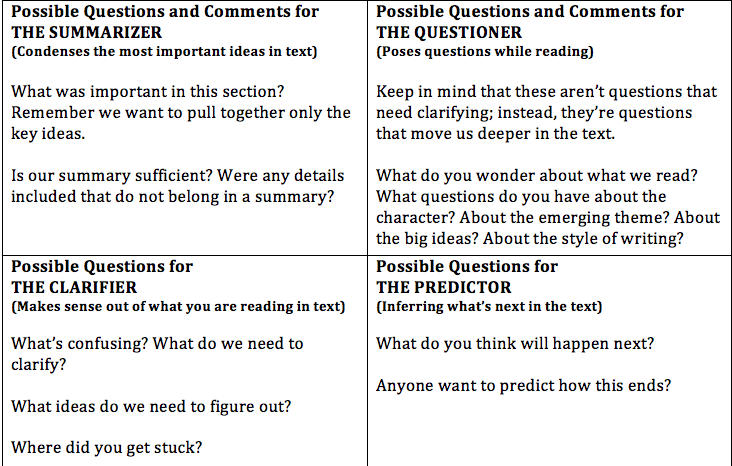
Here is the new card that students used while discussing the Loyalists and Patriots packet:

These roles worked out well with the second packet. They seemed to fit the information a bit better, and helped students to understand not just what the text was saying, but to think through other important elements such as bias and validity. I liked bringing in the CCSS Social Studies/History standards and finding a way for students to practice the reading skills in a meaningful way. 

If anyone has any other creative ways to teach informational reading and/or strategies for tackling complex texts like primary source documents, I'd love to hear about it in the comments.

February 14, 2015

"Is this graded?"

After three heavy weekends of grading and reporting, I can finally come up for air. Oh yeah, of course I still have some work to do-- it's never ending-- but this weekend it's about feedback and not about grading, and it's only about 3 hours' worth instead of 10 hours' worth.

Our middle school faculty is doing a book study of Thomas Guskey's Answers to Essential Questions about Standards, Assessments, Grading, and Reporting (Corwin, 2012). We have been having a lot of discussion about formative assessment: what it is, what it looks like, what to do with it once we have it. We are not new to the concepts of formative and summative assessments. We did a lot of work around those ideas about 5 years ago and have been working with it since. It's pretty surprising, then, how much variety we have as a faculty in our understanding and use of formative assessments.

Five years ago, our middle school made a decision to make our grade books consistent by having two categories of grades: formative (weighted as 15% of the whole grade) and summative (weighted at 85%). This change definitely made a big difference in helping our students and parents understand how grades were being calculated. Before this change, some teachers were counting homework as 85% and tests as 15%, others had standards-based categories (for example, world language teachers had categories for Speaking, Listening, Reading, and Writing-- each weighted as 25% of the total grade), and others had categories that included participation and collaboration. The 85%/15% weighting keeps us teachers focused on using grades to show achievement of standards, rather than behaviors (like participation), and keeps the grade reflective of how well the student can achieve on his/her own (summative assessments like tests and performance tasks and in-class projects) rather than practice opportunities (like homework).

This system has been good for teachers and parents, but we are starting to question the value for students. Students have become "trained" to ask, "Is it formative or summative?" when an assignment is given. Teachers infer that students use the answer to gauge how much effort they should put into completing the assignment: not much if it's formative, quite a bit if it's summative. It makes sense, considering the weighting categories, and our students are not fools. They do what they need to do when playing the game of school. (You can tell I am in the midst of a poetry unit! I may be a poet and not even know it!)

According to Guskey, formative assessments are supposed to give feedback to students about how well they are meeting the standard (and hopefully some information about how to get closer) as well as giving feedback to teachers about how to adjust instruction based on where students are in their learning. Bottom line, formatives shouldn't be graded because their purpose is practice and feedback. 

So our conversations about formative assessments have two sides to them: we understand and agree to the concept that they shouldn't be graded, yet we wonder if students will take them seriously if we don't slap a grade on them (even a small one like 15%). 

I think we can get away from grading formative assessments if we do more work re-training our students to view them as learning opportunities in which they get to practice a skill or strategy and get feedback about how well they are doing before the summative assessment. To that end, I have been watching my language when I make assignments and get the inevitable question, "Is this graded?" I am using the phrases "learning opportunity" and "get feedback" more and more often. 

It's been interesting to see how this response affects students. The students who "get it" really do use the feedback to improve their work. I saw this very clearly when I was grading fantasy stories last weekend (one of the 10-hour work weekends I've been having): students who used the rubric to self-assess and make goals asked for help from peers and me when they got into trouble spots, and made improvements based on that feedback. Their summative assessment results placed them squarely in the A-B range. Those students who went off on their own and disregarded my feedback, did not get help from peers, and didn't see the rubric as a tool to improve their writing, sat squarely in the C-D range. 

I have a selfish interest in the "no grades for formative" debates too-- less grading for me to do! I still need to hold students accountable for doing the practice pieces (homework, in-class activities), but a complete/incomplete designation in the grade book can take care of that. As for "formative feedback", that is work I am glad to take on as long as students use it to make improvements before their summative. 

Now I have to get back to giving feedback on poetry analysis annotations. They will want to use it when they write it up for their summative poetry anthology project.

January 31, 2015

Practicing Argument Strategies during Socratic Smackdown

We are moving into our next phase of argument practice in Social Studies. This section, Towards Revolution, is a series of Town Hall meetings during which students, taking on the role of Patriot, Loyalist, or Neutralist, debate whether the colonies should declare independence from Great Britain. We are drawing upon the work we did earlier with primary source documents (see previous posts from Dec. 6, 2014 and Jan. 10, 2015) and adding an explanation piece (see post from Feb. 22, 2014). The Town Hall meeting itself is a game-based version of Socratic Seminars from The Institute of Play called Socratic Smackdown. Here's how it goes:
  1. Students receive a role card briefly explaining their name, stance (Loyalist, Patriot, or Neutralist), and background (materials and lesson outline from "Towards Independence." United States Through Industrialism. Teacher's Curriculum Press, 2011). These are actual historical people, including John Adams, Benjamin Franklin, John Hutchinson, Joseph Brandt, and many others (including three women). Students are paired up, so the same role goes to two students. This is a scaffold, as well as a means to incorporate collaboration into the activity. Before the first Town Hall meeting, one student from each pair introduces him/herself to the group.
  2. Students build knowledge about a series of historical events. Town Hall meeting 1 focuses on The Proclamation of 1763, The Stamp Act, and the Quartering Act. Town Hall meeting 2 focuses on The Townshend Acts and The Boston Massacre. Town Hall meeting 3 focuses on The Intolerable Acts and The Boston Tea Party. And Town Hall meeting 4 focuses on the battles at Lexington and Concord.
  3. Students evaluate the series of events using evidence to support their opinions. My co-teacher and I noticed on our unit assessment that our students did not entirely understand the "Evidence/Rule/Conclusion" chart they used during the primary source work in December; specifically, they did not quote text or include specific details in the evidence column and they weren't sure what the difference was between Rule and Conclusion. We decided to switch it to a similar, but easier, chart: Say/Mean/Matter. This chart very specifically asks students to record what the text says (quote/detail), what it means (interpretation), and why it matters (significance). We used this new chart during The Great Awakening debate, and it proved to be much more successful than the Evidence/Rule/ Conclusion chart. For this activity, students will use Say/Mean/Matter to evaluate each event. For example, for Town Hall meeting 1, students will take The Proclamation of 1763 and Say what it is (a law that states colonists have to stay to the east and Native Americans to the west of the Appalachian mountains), what it Means (colonists will not be able to expand west into the Ohio and Mississippi river valleys, there will be less fighting between colonists and Native Americans, Native Americans keep the land on which they've lived for generations), and why it matters (this depends on the role, and students will decide whether this was fair or unfair and justify why). They will do the same for the other two Acts.
  4. Students are given the question: At this point in time, how should you and your fellow colonists respond to the British government: Comply (obey without question), Oppose (protest, even if unwilling to rebel), or Rebel (declare independence). They will use their evidence chart and role card to decide what to argue.
  5. Town Hall meeting (using Socratic Smackdown): The first partner brings the role card and evidence chart to the inside circle-- s/he is the speaker and will argue their position. The second partner sits in the outside circle with a score sheet. Listeners give speakers points based on speaking skills such as Agree/ Disagree (+1), Connect and Devil's Advocate (+2), and Interrupt (-1). As a scaffold, I will provide a sentence starter for the speakers: At this point in time, I think we should ______ (comply/oppose/rebel) because British Parliament's actions are _______ (fair/unfair). For example, (name Act, what it means, and why it is fair/unfair). In past years, I have found that students want to jump straight to the Acts without the explanation that makes their point clear. For example, one might say, "I think we should rebel because the Stamp Act was unfair." I provided a similar scaffold during The Great Awakening debate and it helped students structure and support their arguments much better. I am hoping that by repeating that structure over and over, they will get the language in their heads and it will appear in their argument writing later (fingers crossed).
  6. Reflect: Students in both the inner and outer circle reflect on the Town Hall meeting. Speakers consider points that other speakers made that they hadn't thought about, as well as what they could have done better. Listeners note points they could've made if they had been speakers as well as what the speakers did well or needed improvement. They can use the Explanation continuum to help them think through how well they were able to explain their thinking. A quick class discussion gets feedback to the speakers and alerts the listeners for what to do better when it is their turn to speak.
  7. Switch seats. The process repeats for the next Town Hall meeting, with the second partner as the speaker and the first partner as the listener.
By using the same strategies in different contexts, students learn to transfer skills. They will be holding another Document-Based debate in Social Studies in a few weeks. These argument skills will work there too. They are writing argument essays in Science this month. These argument skills will work there too. They will be writing position papers in English later in the school year. These argument skills will work there too. I hope that consistent practice will help them become masters of argument by the end of the year.

January 24, 2015

"Best" Young Adult novels?

Have you seen Time Magazine's list of 100 Best Young Adult novels of all time? I looked over the list this morning. And then, because reading YA fiction is a passion of mine, I read it again, keeping score: I've read 70 of the 100 on the list. That's pretty good I think. 

I wondered why some books were on the list, and why other books weren't. It seemed like "young adult" had a pretty wide age range, from Charlotte's Web (a typical third grade novel) to Little Women, which I seriously doubt was written with young adults in mind. There were a lot of classics, and books that I read as a kid that haven't aged very well. For example, although I love the word play in The Phantom Tollbooth, I've tried to use that book with fifth graders who look at me askance when Milo receives a toy car as a gift (too babyish) and then later with confusion as he journeys through the Tollbooth into the bizarre and random world on the other side. The Wind in the Willows falls into this category too, I think-- the language is too advanced for the target audience.

Another title I have a hard time with is Harry Potter. OK, granted, it's a good story and it was a fresh idea when it came out. But J. K. needed some serious editing help as the books went on to make them tighter and less rambly. Is part of the criteria for inclusion on the "Best" list that it made an impact on young readers? If so, I'll give it the thumbs up; but if it's about "best" as in "good writing", I'd give it a thumbs down. Same for Twilight-- seriously? The writing is repetitive and boring! But it did influence the YA world to open up to paranormal fantasy.

Here are three books I would have liked to see on that list:
Walk Two Moons by Sharon Creech. This book tells a three-layered tale: Sal's cross-country car journey with her grandparents to visit her missing mother (present), Sal's adventures with her next-door neighbor as they try to solve a mystery (recent past), and Sal's life with her mother leading up to her disappearance (further past). The complexity of the plot, which weaves seamlessly together, the fun word-play, scenes that are laugh-out-loud funny and tissue-soaking sad, and lovable characters all combine to make this my #1 favorite young adult novel.


Ender's Game by Orson Scott Card. Six-year-old Ender is sent to Flight
School to learn how to be a soldier and fight the "Buggers" to save the planet. Several issues get attention within this novel: standing up to bullies, empathy for others who are different, working to find your personal best, powerful people manipulate and use the powerless, teamwork and friendship, the value of family.
 

The Night Circus by Erin Morgenstern. This may fall into the "not written with young adults in mind" category, but it is certainly appropriate for the older end of the audience. Two rival magicians pit their innocent young apprentices in a competition against each other with surprising and delightful results. I loved the fresh new ideas within this novel, which was told in a "can't put it down" compelling style.


What are your favorite young adult novels? Did they show up on Time's list? If not, which ones would you have recommended?

January 10, 2015

Using Close Reading of Multiple Sources to Get Away from the "Single Story" of US History

Teaching history is the art of storytelling. But storytelling has its dangers, as Chimamanda Ngozi Adichie, author of my January adult book club book Americanah, warns in her TED talk "The Danger of a Single Story." She warns that only telling one story of a people leads to stereotyping and false assumptions, such as disregarding her Nigerian middle class upbringing as not "authentic", according to one of her American college professors, because it wasn't the starving/sick/poor/hard-scrabble story we Americans hear about Africans from our media. She asserts that only by telling multiple stories will we get the true meaning.

This idea of multiple stories, multiple sources, is a topic explored by Mary Janzen in her 6 Jan 2015  SmartBlog post "Using digital resources to enhance social studies, history instruction." She argues that the textbook version is too narrow, that it's the "single story", and that adding digital resources including many primary source documents, helps students to see history from multiple perspectives, without stereotyping or narrowing to only one story.

As we jump back into Early American History next week, my co-teacher and I are pushing pause before moving forward in the chronology. We finished our Colonial America unit right before the winter break, so we are going to linger for a couple weeks in some of the big ideas that formulate the Promise of America, our year-long theme. Many of the "promises" were formed during the colonial era: freedom of religion, self-governance, the free enterprise system, and equality (within contextual boundaries, of course).

One of the defining movements during the early 18th century was The Great Awakening, a time when itinerant Christian preachers spread ideas of breaking away from authoritarian religious practices, like the Puritans, and embracing the right to practice religion in a way that allows the common person to have a direct relation with God. A central tenant was that everyone is "equal" in the eyes of God, a very radical viewpoint for the times. Here is what the textbook closes its three paragraphs with: "By encouraging ideas of liberty, equality, and self-reliance, the Great Awakening helped pave the way for the American Revolution." (TCI, 2011).

So that's the single story: Preachers preached, people converted to their ideas, and the American Revolution was born. Hold on... we all know it's not that simple.

We are going to use the resource What Did the Great Awakening Awaken? (Social Studies School Services, 2007), a collection of primary source documents, both visual and written, that presents two sides of the story: the religious revivalists and the authoritarian establishment. It is set up to be used as a DBQ (Document-Based Question), with guided reading questions to scaffold understanding the documents before answering the question: "'The Great Awakening taught colonial Americans to challenge religious authority forcefully. This helped prepare them for the political revolution to come.' Assess the validity of this statement." However, instead of asking students to write a DBQ essay, we're going to hold a debate. This will build on our previous work with finding evidence, stating a rule, and drawing a conclusion (see previous post on this). Students will need to draw evidence from the primary sources to use in their debate argument, and justify their thinking with the rules and conclusions.

But first, students need to understand the sources. Eighteenth century writing style is very different from 21st century (especially digital and social media) writing style. Sentences are long; grammatical constructs are complicated; they use big words! Our eighth graders will struggle to understand the writing. This is why we are going to use Reading Workshop (mini-lessons on how to read informational text) and Reciprocal Teaching, a strategy we learned from visiting consultant Stevi Quate, to help them learn to read difficult texts. Groups of four students assume roles, and they tackle small chunks of the text together. Roles are rotated with each document, so students get practice with each type of thinking. Here is a "cheat sheet" we'll give students to help them get started:

There are four primary source documents in What Did the Great Awakening Awaken? That gives each student a chance to try out each role. By practicing this kind of thinking in a very structured, supported way, students will begin to internalize the strategies, and move closer to being able to read difficult texts independently. We'll see how well they do, and reassess how much scaffolding they need for our next Debating the Documents packet: Patriots and Loyalists. We may need to stay here for a while, or possible back off to pairs (each student gets two roles). By the time of the assessment, they should be able to tackle a text independently. But that's way down the road.